
The Rise of Cloud-Connected Medical Devices and the Future of Care Delivery
December 29, 2025
From Concept to Care: End-to-End Product Engineering of a CPAP/BiPAP Respiratory Device System
January 15, 2026The Rise of Cloud-Connected Medical Devices and the Future of Care Delivery
December 29, 2025From Concept to Care: End-to-End Product Engineering of a CPAP/BiPAP Respiratory Device System
January 15, 2026Bringing Real-Time Medical Device Data into Hospital Management System (HMS)

Client's Challenge
Modern hospitals rely on hundreds of medical devices at the bedside and across departments. Patient monitors, ventilators, infusion pumps, imaging systems, and specialty diagnostic devices used in the outpatient department (OPD) continuously generate critical patient data. However, this data often remains locked within individual devices or vendor-specific systems.
In this hospital’s case, clinicians were using an enterprise Hospital Information Management System (HMS) for patient and asset management, but they did not have easy, real-time access to data coming from connected medical devices. Switching between multiple systems slowed clinical workflows and limited timely decision-making.
The hospital needed a way to:
- View real-time device data on demand
- Work with multiple device brands and models
- Use the existing HMS interface without adding another clinical application
- Avoid storing raw device data permanently in the HMS
- Ensure that patient data does not leave the hospital premises in line with its data governance and patient privacy policies
The Environment
- ~190 medical devices
- 30+ device types across 15+ manufacturers
- Major global patient monitor and ventilator OEMs, along with several specialty device manufacturers
- Devices produced a mix of:
- Numeric vital signs
- Continuous waveforms (e.g., ECG)
- Imaging data (e.g., ultrasound)
This highly diverse environment required a solution that was flexible, scalable, and vendor-neutral.
iOrbit Solution
The hospital partnered with iOrbit to integrate its medical devices with the HMS using the iTouch IoMT platform.
iTouch is designed to connect with multi-vendor, multi-device hospital environments, enabling secure collection, normalization, and delivery of medical device data—without disrupting existing clinical systems.
Using iTouch, real-time device data is made available inside the HMS, mapped to the correct patient and device, and displayed only when needed.
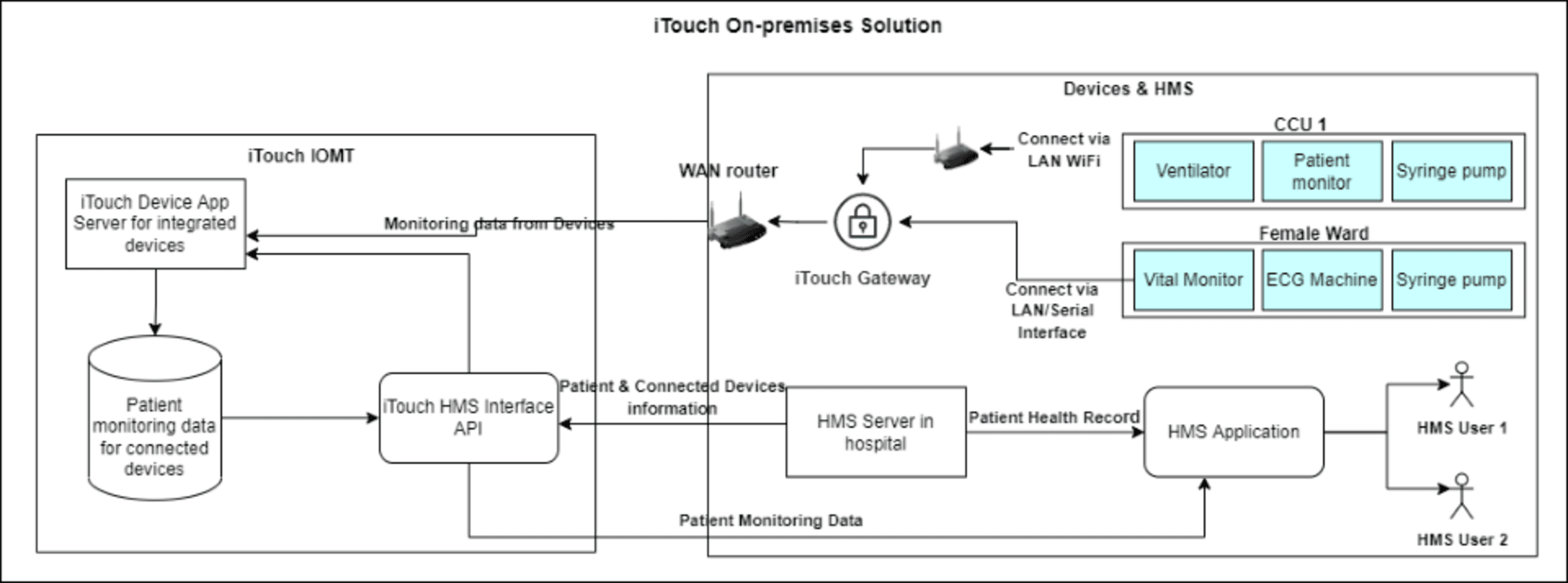
How it Works
1. Device Connectivity
iTouch connects to medical devices using standard and proprietary protocols such as HL7, DICOM, FHIR, Ethernet, Wi-Fi, and serial interfaces. Where required, gateways are used to bridge legacy or non-networked devices.
2. Data Normalization & Mapping
Data from different devices is standardized and linked to the correct patient and asset, creating a consistent and reliable view regardless of device manufacturer.
3. HMS Integration
iTouch integrates with the HMS through secure APIs. Patient and device context is exchanged, enabling the HMS to request and display real-time monitoring data on demand.
4. Embedded Clinical View
Device data is embedded directly into the HMS user interface. Clinicians continue working in a familiar system, with no need to log into a separate application. Single Sign-On (SSO) ensures a seamless experience.
Phased Implementation
To minimize disruption, the solution was rolled out in phases:
- Initial pilot with selected devices
- Validation of data accuracy and clinical usability
- Gradual onboarding of additional devices and departments
All device data is stored securely on the hospital’s on-premise iTouch installation, aligned with the hospital’s IT and data governance policies.
Outcome
- Unified view of medical device data within existing HMS
- Faster access to real-time patient information at the point of care
- Reduced dependency on multiple vendor-specific systems
- Scalable foundation for adding new devices in the future
- Improved clinical workflow efficiency without changing existing HMS processes
Business & Clinical Impact
By using iTouch as a medical device integration layer, the hospital transformed a complex, multi-vendor device environment into a single, HMS-centered clinical experience. Clinicians gained timely access to critical device data, while IT teams benefited from a standards-based, future-ready integration platform.
Conclusion
This case study highlights how iTouch enables hospitals to unlock real-time medical device data and bring it directly into their core clinical systems. Without replacing existing infrastructure, hospitals can improve visibility, streamline workflows, and take a major step toward a connected, interoperable care environment.