Device-Agnostic Platform: 7 Ways It Powers Connected Care
July 10, 2026
IoMT Master Class: Building Software for IoMT Devices
July 22, 2026Device-Agnostic Platform: 7 Ways It Powers Connected Care
July 10, 2026IoMT Master Class: Building Software for IoMT Devices
July 22, 2026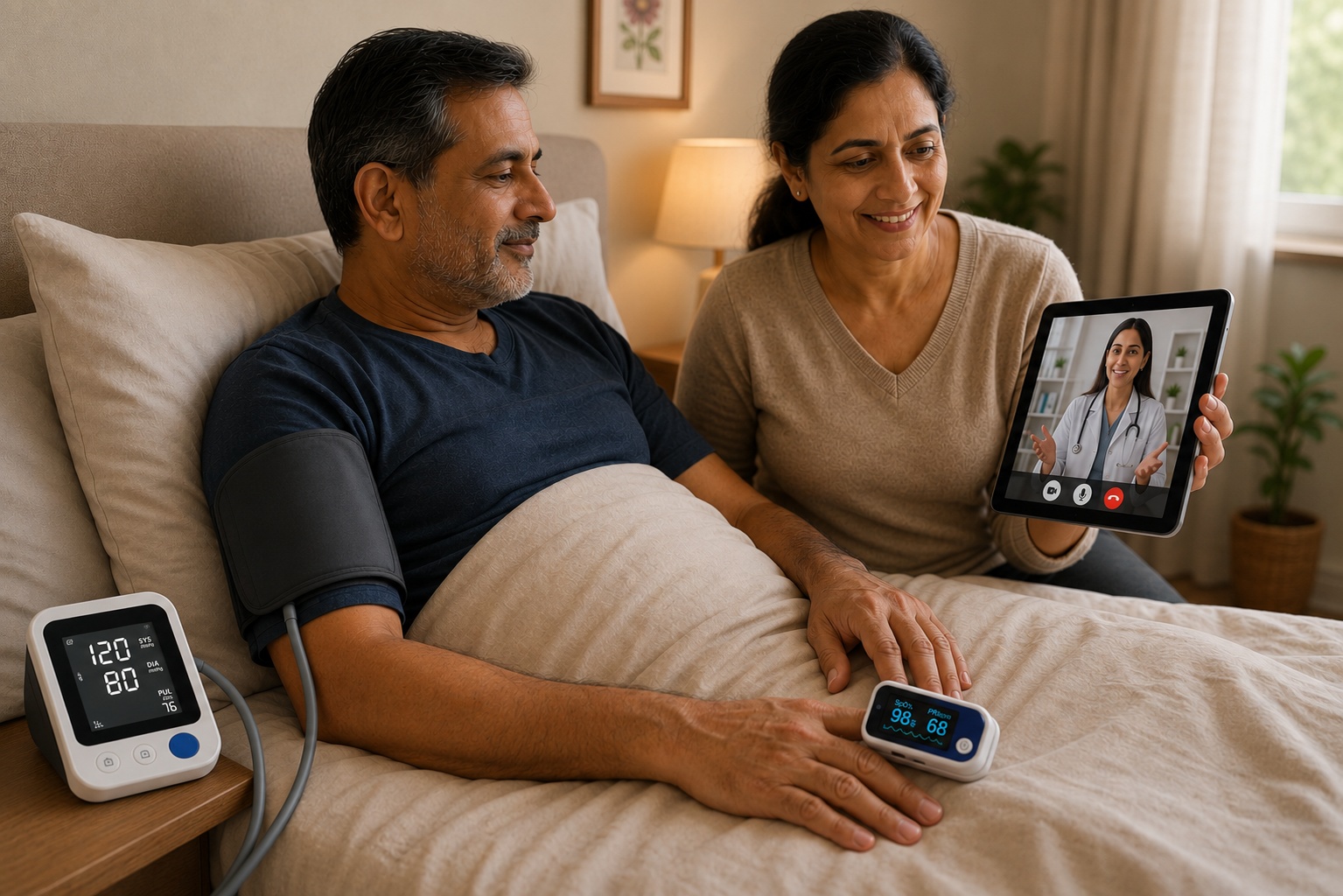
From ICU to Home Care: How iTouch Enables Continuous Remote Patient Monitoring
Real-world monitoring workflows across critical care, step-down units, and telehealth — held together by one platform.
A patient’s journey rarely ends where monitoring does. As people move from the ICU to a general ward, then home, the data that kept them safe is often lost at each handoff. Continuous remote patient monitoring closes those gaps by carrying one live stream of clinical data across every setting. This article walks through five real-world workflows -from critical care to elder care and shows how iTouch keeps clinicians connected to the patient the whole way.
In most hospitals, monitoring is intense in the ICU and thins out with every step toward discharge. High-frequency vitals in critical care give way to spot checks on the ward, and once a patient goes home, visibility can disappear almost entirely until the next appointment or the next emergency. Each transition is a handoff, and each handoff is a place where signal is lost.
This is the problem continuous remote patient monitoring is built to solve. Instead of separate monitoring islands for the ICU, the ward, and the home, a single platform follows the patient across the entire care continuum -collecting data from whatever device is appropriate at each stage and presenting it to the right care team in real time. iOrbit’s remote patient monitoring capability, powered by the iTouch platform, is designed for exactly this.
What "Continuous" Really Means in Remote Patient Monitoring
Plenty of tools can monitor a patient in one place. What makes monitoring continuous is that the data does not stop -and does not reset -when the patient changes location, device, or care team. Three things have to be true:
- Device independence. A bedside monitor in the ICU, a wearable on the ward, and a home blood-pressure cuff must all feed the same record, regardless of manufacturer.
- A single longitudinal view. Clinicians see one continuous timeline of the patient, not five disconnected snapshots.
- Context that travels. Baselines, alert thresholds, and trends move with the patient so early-warning signals are not lost at handoff.
Put together, these three requirements are what separate continuous remote patient monitoring from a collection of disconnected monitoring tools.
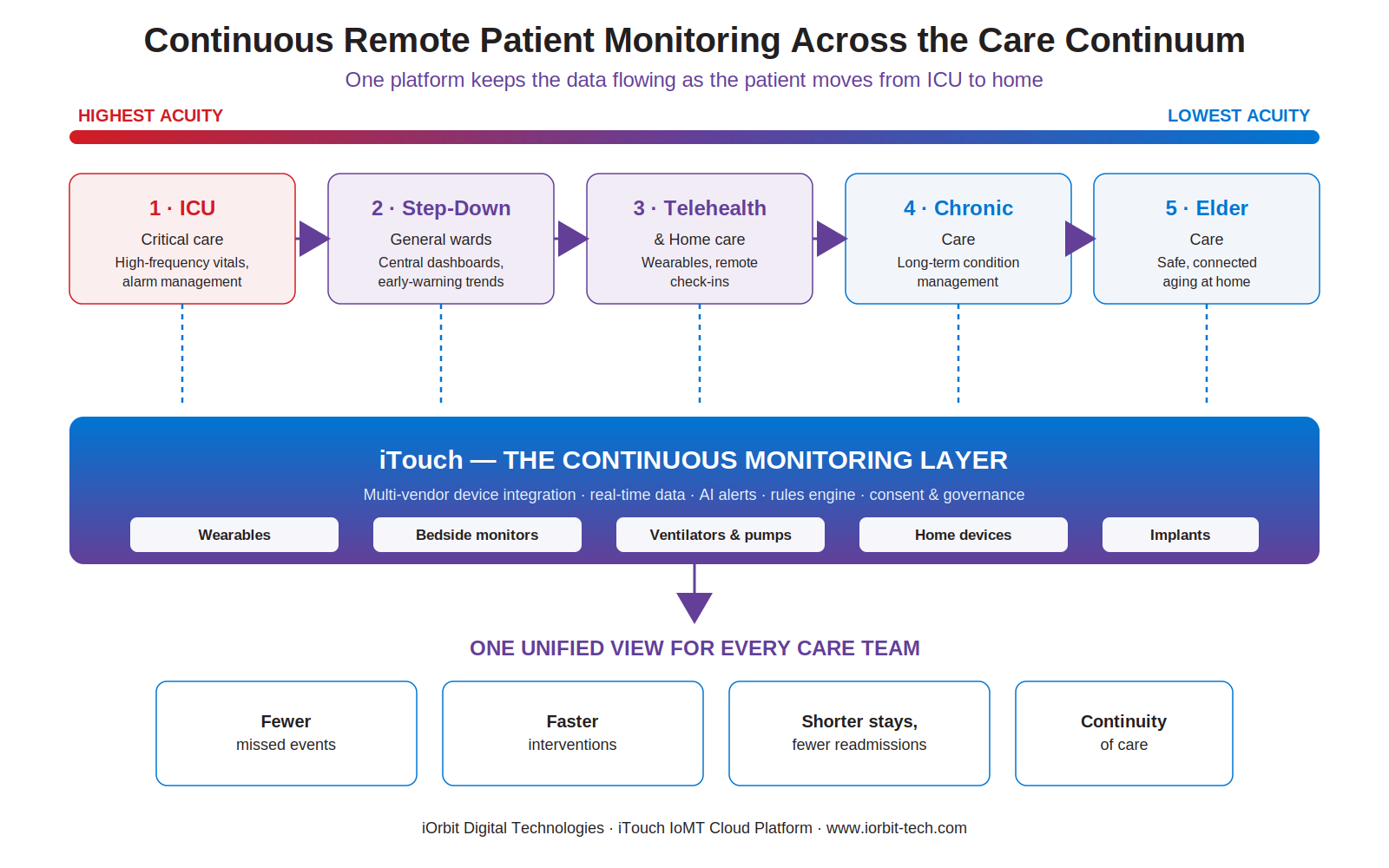
Figure 1: iTouch acts as the continuous monitoring layer, carrying one data stream across every care setting from ICU to home.
5 Real-World Continuous Monitoring Workflows
Here is how continuous remote patient monitoring plays out in practice across five settings along the care continuum.
1. Critical Care (ICU)
In the ICU, continuous remote patient monitoring is dense and time-critical. Ventilators, infusion pumps, and multi-parameter monitors stream data continuously, and the challenge is not collecting it but making sense of it without drowning staff in alarms. iTouch aggregates every bedside device into a unified view and applies a configurable rules engine so that clinically meaningful alerts rise above the noise. This is the foundation of effective ICU alert management -fewer false alarms, faster response to the ones that matter.
2. Step-Down & General Wards
As patients stabilize and move to step-down units and general wards, monitoring shifts from bedside-intensive to trend-based. Nurses cover more patients with less equipment per bed, so early detection of deterioration depends on spotting subtle multi-parameter trends. A central vitals monitoring dashboard lets a single station watch an entire ward, surfacing early-warning scores before a patient crashes. Because the ICU data and thresholds carried over, the ward team starts with full context rather than a blank slate.
3. Telehealth & Home Care
Discharge should not mean disappearance. With wearables and connected home devices, the same platform continues to follow the patient after they leave the building -capturing vitals, flagging concerning trends, and enabling remote check-ins. This continuity is what turns a discharge into a managed transition rather than a cliff edge, extending patient-centric care beyond the hospital walls. Telehealth visits become far more useful when the clinician is looking at real data, not just asking how the patient feels.
4. Chronic Disease Management
For patients living with conditions like hypertension, diabetes, COPD, or heart failure, monitoring is not a phase -it is ongoing. Continuous remote patient monitoring lets care teams track physiologic data over months, intervene at the first sign of drift, and adjust treatment before a manageable problem becomes an admission. The value here is proactive rather than reactive care: catching the slow slide, not just the acute crisis.
5. Elder Care
For aging populations, safety and independence often pull in opposite directions. Continuous monitoring in elder care settings -assisted living, retirement communities, or a family home -lets caregivers keep a protective eye on vitals, activity, and safety events without hovering. It supports connected, dignified aging while giving families and clinicians early warning when something changes.
Every one of these workflows depends on the same thing: data that does not break when the patient moves. The setting changes, the devices change, the care team changes -but the monitoring stays continuous. That unbroken thread is what separates true continuous remote patient monitoring from a collection of disconnected tools
The Business Case: Outcomes, Efficiency & Reimbursement
Continuous monitoring is a clinical win, but it is also an operational and financial one -which matters to administrators and sales teams making the case internally.
- Better outcomes. Earlier detection of deterioration means faster intervention, fewer adverse events, and lower readmission rates.
- Operational efficiency. Central dashboards let smaller teams safely cover more patients, and fewer false alarms reduce nurse burnout.
Reimbursement momentum. In the United States, Medicare has covered remote patient monitoring since 2018, with a defined set of billing components for device setup, data transmission, and treatment management. National telehealth and RPM billing guidance continues to expand, turning continuous monitoring from a cost center into a sustainable, reimbursable service line.
How iTouch Makes Continuous Monitoring Work
The iTouch IoMT Cloud Platform is purpose-built to interface with a wide range of medical devices -wearables, patient monitors, ventilators, and imaging systems -so a patient’s data stays unified no matter which device is collecting it. Key enablers of continuous monitoring include:
- Multi-vendor device integration across protocols from Bluetooth to DICOM, so any appropriate device can feed the record.
- Real-time data collection and visualization from critical-care, imaging, and wearable devices in one view.
- An intelligent rules engine and AI module for configurable, clinically meaningful alerts and early-warning insights.
- HL7 and FHIR integration so monitoring data flows cleanly into the EHR and other systems. (HL7 FHIR)
- Flexible deployment and modular scale from a single clinic to a multi-site hospital network, on cloud, hybrid, or on-prem.
- Medical-grade security, consent, and governance built in, keeping continuous data flows compliant with regional and global regulations.
Continuous remote patient monitoring is not about adding more devices -it is about never losing the thread. When one platform carries the patient’s data from the ICU to the ward to the home, care teams intervene earlier, hospitals run more efficiently, and patients stay connected to their clinicians wherever they are. With iTouch, the monitoring follows the patient -not the other way around.
Extend Monitoring Across Every Care Setting
If your organization is looking to close the gaps between the ICU, the ward, and the home, continuous remote patient monitoring is where to start. See how iTouch can unify your devices and carry one live data stream across the entire care continuum: ">iOrbit iTouch IoMT Cloud Platform.