

iORBIT 10 Year Celebration | A Decade in Healthcare
September 17, 2026iORBIT 10 Year Celebration | A Decade in Healthcare
September 17, 2026
How iTouch Accelerates Connected Healthcare: Performance Metrics from Real-World Deployments
Six measurable improvements - from integration effort to device uptime - based on real-world implementation experience and engineering analysis.
Claims about a platform's benefits are easy to make and hard to verify. This article takes a different approach: presenting six specific, measurable performance metrics from iTouch's real-world deployments, engineering effort analysis, and customer observations - compared directly against conventional custom-built healthcare integration. From integration effort to device uptime, each metric includes the methodology behind it, so hospital and OEM decision-makers can evaluate the numbers on their own terms, not just take them on faith.
Every healthcare technology vendor claims their platform saves time and money. What's harder to find is the actual methodology behind those claims - how the number was calculated, what it's being compared against, and where the estimate might vary. This article lays out iTouch's performance data with exactly that level of transparency: six metrics, each with the conventional-approach baseline, the iTouch approach, and the calculation methodology behind the improvement.
These iTouch platform performance metrics are based on real-world implementation experience, engineering effort analysis, internal project estimates, and customer deployment observations - not theoretical projections.
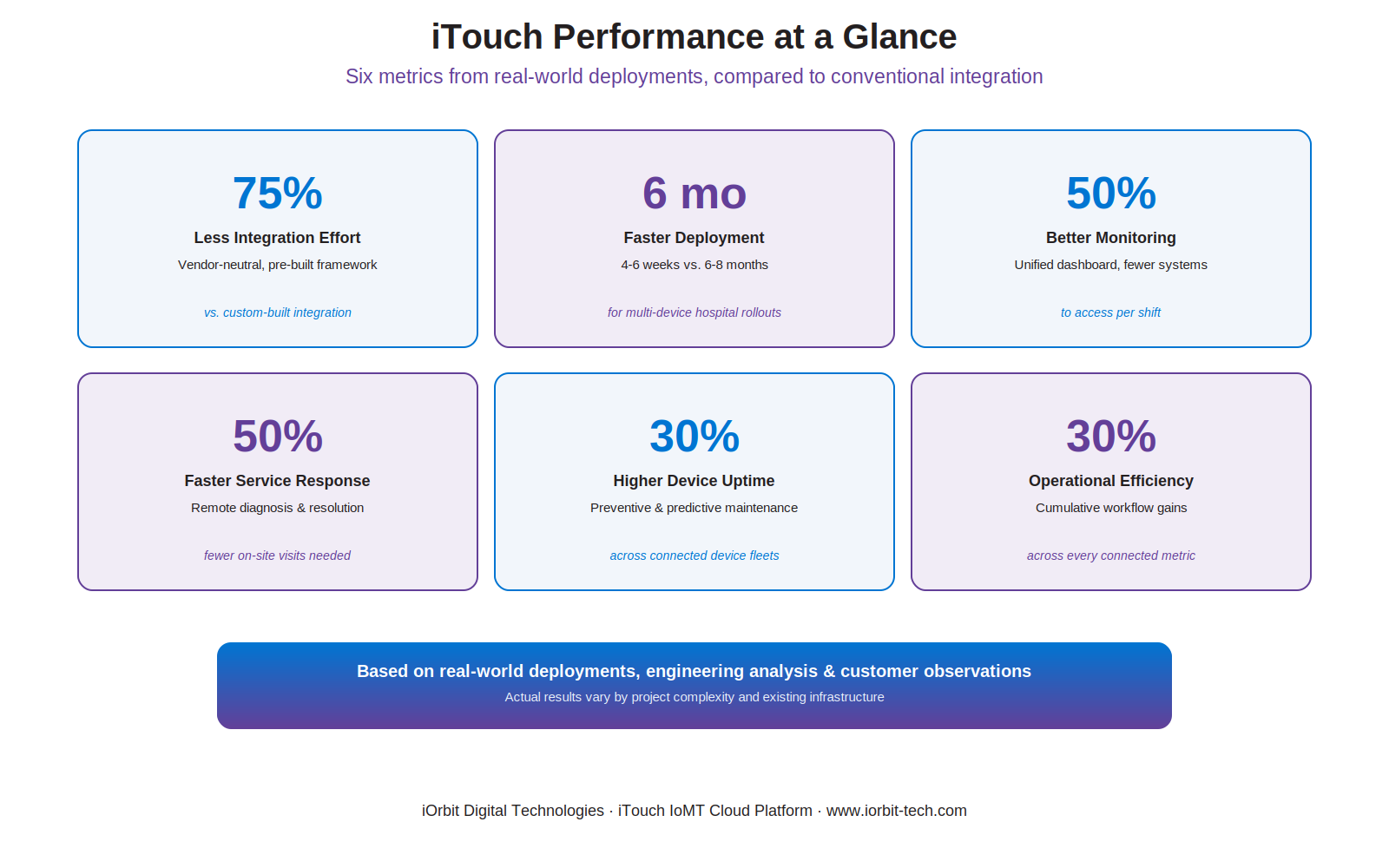
1. Up to 75% Reduction in Integration Effort
Conventional hospital integration requires engineering teams to individually develop, test, and maintain interfaces for every medical device and software application - across multiple manufacturers, communication protocols (HL7, FHIR, ASTM, DICOM, and proprietary formats), legacy RS232/Serial equipment, modern Ethernet/Wi-Fi devices, and custom APIs for HIS, EMR, LIS, and PACS systems.
iTouch addresses this through three architectural capabilities: a vendor-neutral integration architecture that removes dependence on individual OEM ecosystems, a pre-built integration framework supporting common healthcare communication standards, and iTouch Hub, an edge gateway connecting both legacy and modern devices via RS232, USB, Ethernet, Wi-Fi, and other industry-standard interfaces.
| Activity | Conventional Integration | Using iTouch |
|---|---|---|
| Device protocol development | 35-40% | Minimal |
| Interface development | 25-30% | Mostly configuration |
| Connectivity development | 15-20% | Pre-built |
| Testing & validation | Similar | Similar |
| Business workflow configuration | Similar | Similar |
Because nearly three-fourths of the engineering work tied to connectivity and protocol development already exists within the platform, overall integration effort is typically reduced by up to 75%, depending on project complexity.
2. Up to Six-Month Reduction in Deployment Time
A typical enterprise healthcare integration project - device protocol development, interface development, connectivity validation, integration testing, security implementation, user acceptance testing, and deployment - commonly requires 6-8 months for medium to large hospitals across multiple departments and vendors.
A typical enterprise healthcare integration project - device protocol development, interface development, connectivity validation, integration testing, security implementation, user acceptance testing, and deployment - commonly requires 6-8 months for medium to large hospitals across multiple departments and vendors.
| Conventional | With iTouch |
|---|---|
| 6-8 months | 4-6 weeks |
This represents an acceleration of approximately six months for typical multi-device hospital integration projects.
3. Up to 50% Improvement in Monitoring Efficiency
Monitoring efficiency improves because iTouch transforms fragmented device monitoring into a unified, real-time clinical view:
- Unified device visibility. Clinical staff view data from multiple devices in one dashboard instead of accessing separate consoles.
- Anytime, anywhere access. Authorized users securely access real-time patient and device data from desktop, tablet, or mobile.
- Proactive monitoring. Continuous monitoring of connected devices and patient parameters supports earlier issue identification than manual or periodic checks.
- Intelligent alarm management. Configurable prioritization reduces non-actionable alerts and suppresses repetitive notifications, helping reduce alarm fatigue and keep staff focused on higher-priority cases.
Based on workflow analysis before and after platform implementation - measuring status-review time, number of systems accessed, time to identify actionable events, and response to critical alarms - organizations typically see up to a 50% improvement in monitoring efficiency, depending on the degree of workflow digitization.
4. Up to 50% Reduction in Service Response Time
iTouch enables OEMs and biomedical engineering teams to remotely monitor deployed devices throughout their operational lifecycle - continuous health monitoring, remote diagnostics, device log collection, software and firmware updates, predictive maintenance alerts, and remote configuration management. Many issues that traditionally required an on-site engineer can instead be diagnosed and resolved remotely, with more than 50% of service incidents typically resolved remotely in iOrbit's deployment experience.
Conventional workflow: Issue → Service call → Engineer scheduling → Site visit → Diagnosis → Resolution. With iTouch: Issue → Automatic alert → Remote diagnosis → Remote resolution (where applicable).
By eliminating travel time and accelerating diagnosis, organizations typically achieve up to a 50% reduction in average service response time.
5. Up to 30% Improvement in Device Uptime
The same remote service capabilities also improve equipment availability — continuous health monitoring, early fault detection, preventive maintenance scheduling, remote software updates, predictive maintenance, and faster issue resolution all reduce the time a device remains unavailable. Device uptime is measured as: Available Operating Time ÷ Total Scheduled Operating Time × 100.
By reducing downtime through preventive maintenance and remote support, healthcare providers typically realize up to a 30% improvement in device uptime, particularly for large fleets of connected devices.
Every one of these metrics traces back to the same architectural decisions: a vendor-neutral, pre-built integration framework and remote device management built directly into the platform. Less time spent building integrations means faster deployment; better visibility means more efficient monitoring; remote diagnostics mean faster service response and higher uptime. These aren't six separate improvements — they're the compounding effect of one architectural choice.
6. Up to 30% Improvement in Operational Efficiency
Operational efficiency is the cumulative outcome of improvements across every workflow the platform touches — reduced integration effort, faster implementation, centralized device management, unified clinical dashboards, improved monitoring workflows, faster service response, higher device availability, reduced manual data collection, lower administrative overhead, and improved interoperability across clinical systems.
Assessed using indicators such as engineering effort saved, time-to-deployment, clinical workflow improvements, biomedical engineering productivity, device utilization, and service turnaround time, the combined effect typically results in up to a 30% increase in overall operational efficiency — with the exact outcome depending on an organization's existing infrastructure, number of connected devices, and level of digital maturity.
Across integration effort, deployment time, monitoring efficiency, service response, device uptime, and operational efficiency, iTouch's real-world performance metrics point to the same conclusion: a vendor-neutral, pre-built platform architecture doesn't just add convenience — it measurably compounds savings across every stage of a hospital's connected care journey. These are the numbers behind that outcome, methodology included.
See the Numbers for Your Own Deployment
Actual results vary by project complexity and existing infrastructure, but the architectural principles behind these metrics are consistent. Explore the iTouch IoMT Cloud Platform and see how a vendor-neutral, pre-built integration framework could perform for your organization.