

Real-Time Data, Real-Time Decisions: 4 Steps That Save Minutes
October 16, 2026
Vendor-Neutrality Hospital IT: How to Future-Proof Your Investment
November 6, 2026Real-Time Data, Real-Time Decisions: 4 Steps That Save Minutes
October 16, 2026Vendor-Neutrality Hospital IT: How to Future-Proof Your Investment
November 6, 2026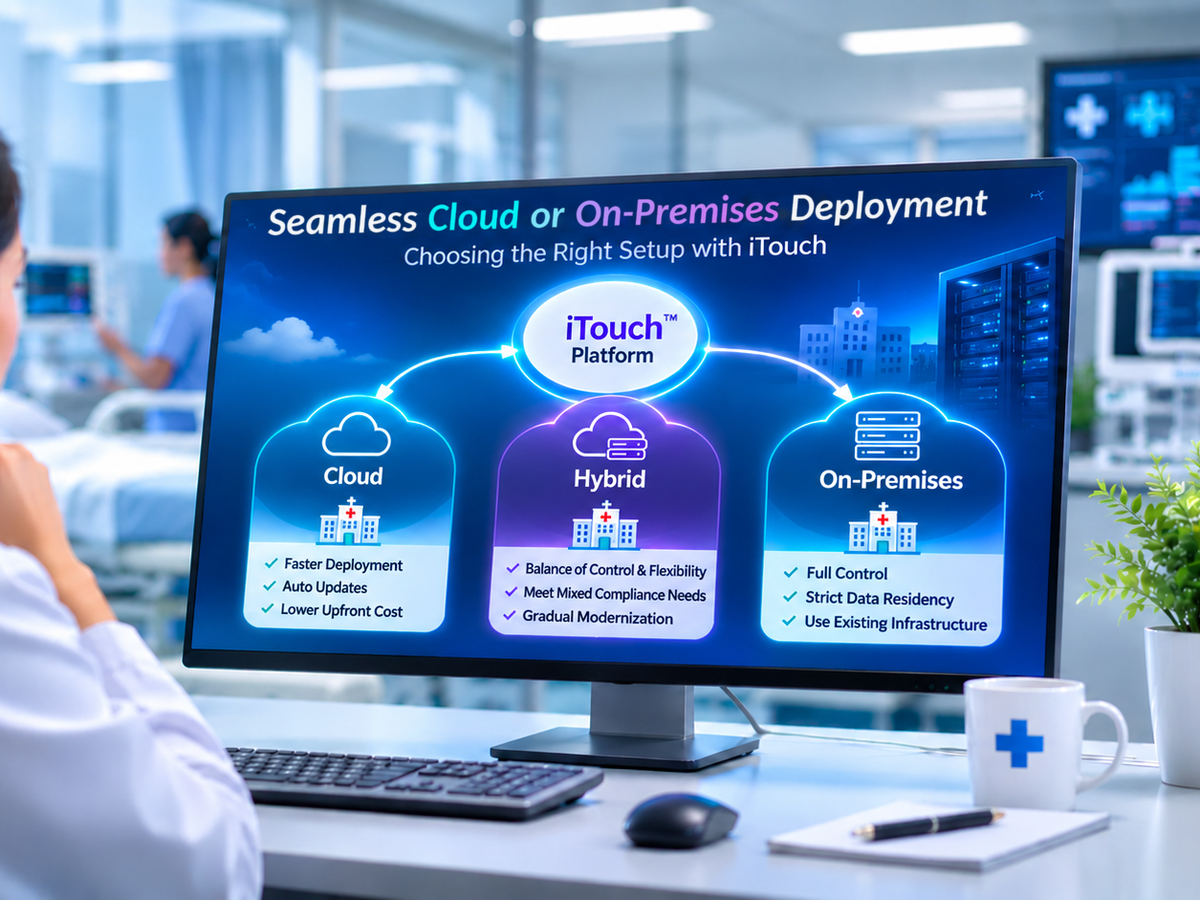
Seamless Cloud or On-Premises Deployment: Choosing the Right Setup with iTouch
A guide for IT leaders weighing deployment options against flexibility and compliance requirements.
Cloud, on-premises, or hybrid - the deployment decision shapes cost, control, and compliance for years. There's no universally right answer; the right choice depends on your data residency requirements, existing infrastructure, and growth plans. This article breaks down all three deployment models for iTouch, what each is best suited for, and how to decide without locking yourself into the wrong one.
Cloud or on-premises deployment is one of the biggest decisions a hospital makes. Ask ten hospital IT leaders which is right and you’ll likely get ten different answers, because it genuinely depends on the organization asking. A specialty clinic with light compliance overhead has very different needs than a large hospital network operating under strict data residency regulations.
On-premises means the platform runs on servers inside your own hospital, managed by your own IT team. Cloud means it runs online on a provider’s servers.
The good news is that this decision doesn’t have to be permanent or all-or-nothing. Understanding cloud or on-premises deployment options, and where a hybrid approach fits, lets IT leaders choose what’s right for today while staying flexible for tomorrow.
Cloud or On-Premises Deployment: The Three Models
Cloud Deployment
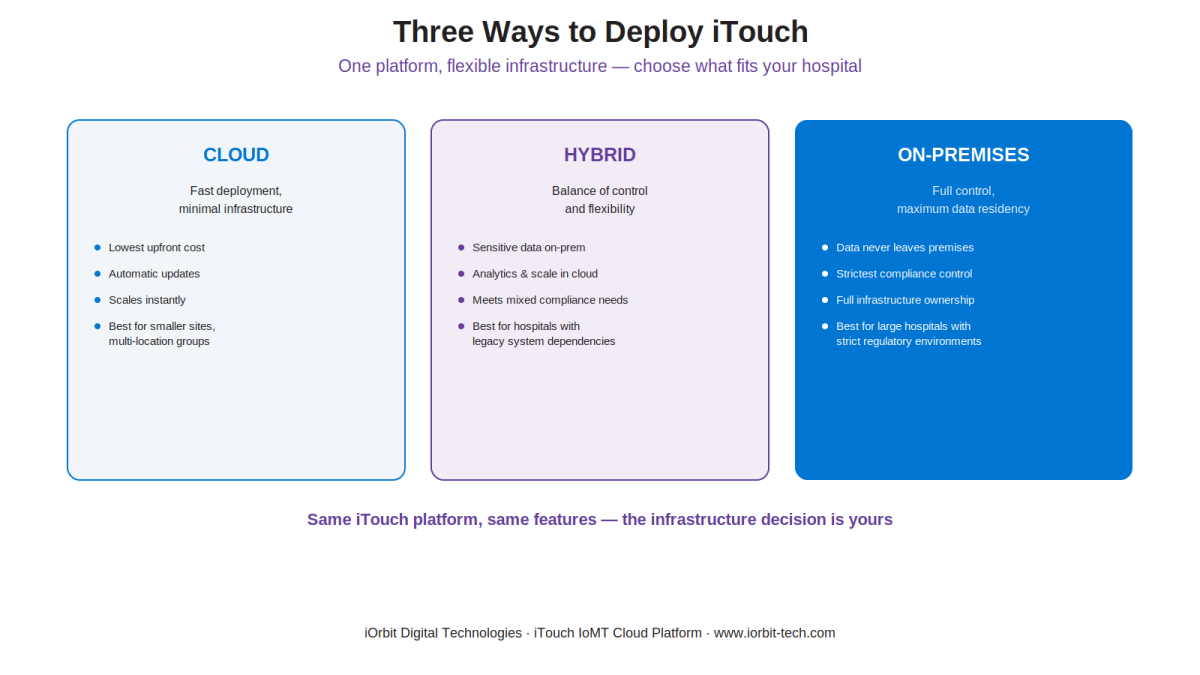
Cloud deployment gets a facility up and running fastest, with minimal infrastructure investment. Updates happen automatically, scaling is nearly instant, and the total cost of ownership is typically lower upfront. This model suits smaller clinics, multi-location groups prioritizing speed of rollout, and organizations without the internal IT resources to manage on-site servers. In a cloud or on-premises deployment decision, this is usually the speed-first choice.
For US organizations, the HHS guidance on HIPAA and cloud computing confirms that covered entities may use cloud services to store or process ePHI, provided a HIPAA-compliant business associate agreement is in place.
On-Premises Deployment
On-premises deployment keeps all data and infrastructure inside the hospital’s own walls, giving IT teams full control and the strictest possible data residency guarantees. This model is often the right fit for large hospital systems operating in tightly regulated environments, or organizations with existing infrastructure investments they want to leverage rather than replace. In cloud or on-premises deployment decisions, on-premises wins on control and data residency.
Hybrid Deployment
Hybrid deployment splits the difference: sensitive patient data stays on-premises while analytics, scaling, and less sensitive workloads run in the cloud. This model is common for hospitals navigating mixed compliance requirements across departments, or those in a transitional phase between legacy on-premises systems and a longer-term cloud strategy. Hybrid is often the practical middle path in a cloud or on-premises deployment decision.
Regardless of which model an organization chooses, the underlying platform and its features stay identical. That's the point of building deployment flexibility into the architecture from the start: the infrastructure decision becomes a business and compliance choice, not a technical constraint that limits what the platform can do.
How to Choose: Key Questions for IT Leaders
- What are your data residency requirements? Some regulations or organizational policies require patient data to remain within specific physical or geographic boundaries - this often points toward on-premises or a carefully scoped hybrid approach.
- What's your existing infrastructure investment? Organizations with recently upgraded on-site servers may prefer hybrid or on-premises to protect that investment; those without existing infrastructure often find cloud faster and cheaper to start with.
- How quickly do you need to deploy? Cloud deployment is typically the fastest path to going live, which matters for time-sensitive rollouts or rapid expansion.
- How will your needs change over the next 3-5 years? A growing multi-site network may want to start cloud and shift toward hybrid as compliance complexity increases with scale.
Why Flexibility Matters More Than the Initial Choice
The organizations that get the most value from their deployment decision aren't necessarily the ones that pick perfectly on day one - they're the ones that chose a platform built to support all three deployment models from the start. That flexibility means a shift from cloud to hybrid, or on-premises to hybrid, doesn't require a platform migration - just an infrastructure adjustment.
There is no single right answer to cloud versus on-premises deployment - only the right answer for your organization's compliance needs, existing infrastructure, and growth trajectory. What matters most is choosing a platform, like iTouch, that supports all three models equally well, so your deployment decision today doesn't become a constraint on your organization tomorrow.
Deploy on Your Terms
Whether your organization needs cloud speed, on-premises control, or a hybrid balance of both, the right platform should adapt to you. Explore how the iTouch IoMT Cloud Platform supports flexible deployment across cloud, hybrid, and on-premises environments.