
Real-Time Data, Real-Time Decisions: 4 Steps That Save Minutes
October 16, 2026Real-Time Data, Real-Time Decisions: 4 Steps That Save Minutes
October 16, 2026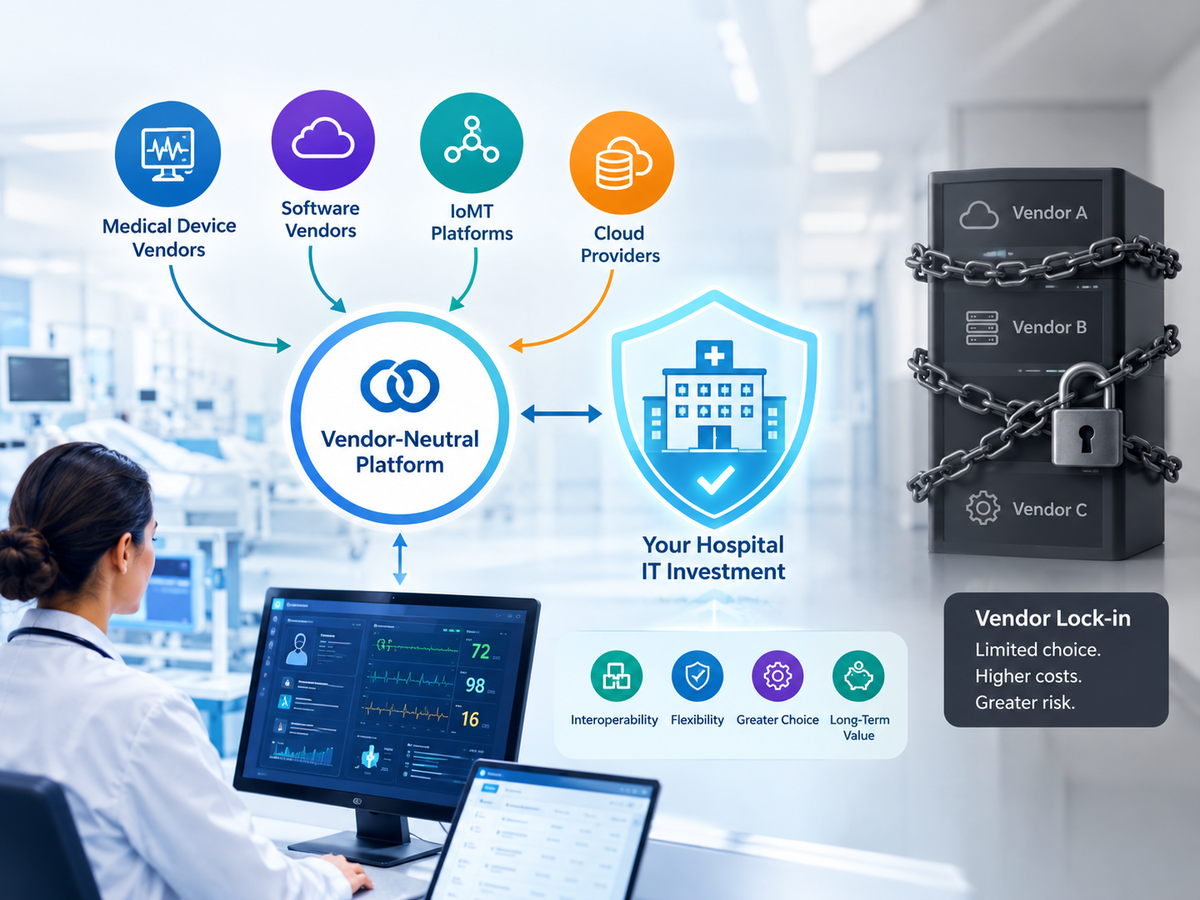
Vendor-Neutrality Hospital IT: How to Future-Proof Your Investment
Cost savings, flexibility, and future-readiness - what administrators should know before locking into a single-vendor ecosystem.
Every hospital IT investment is also a bet on the future - a bet that today's choice will still make sense in five or ten years. Vendor lock-in makes that bet riskier: it ties your organization's flexibility to one supplier's roadmap, pricing, and pace of innovation. Vendor-neutrality is the alternative - an approach that keeps your options open no matter how the technology landscape shifts. This article explains why vendor-neutrality, not any single feature or price point, is the real key to future-proofing your hospital IT investment.
Every technology purchase a hospital makes is, whether anyone frames it this way or not, a long-term commitment. Devices, platforms, and systems aren't swapped out casually - the capital cost, the training, and the integration work all create inertia that keeps an organization on its chosen path for years.
That's exactly why the decision of vendor-neutrality versus vendor lock-in matters so much. It's not a minor technical preference - it determines how much flexibility your organization retains for every decision that comes after this one.
The Hidden Cost of Vendor Lock-In
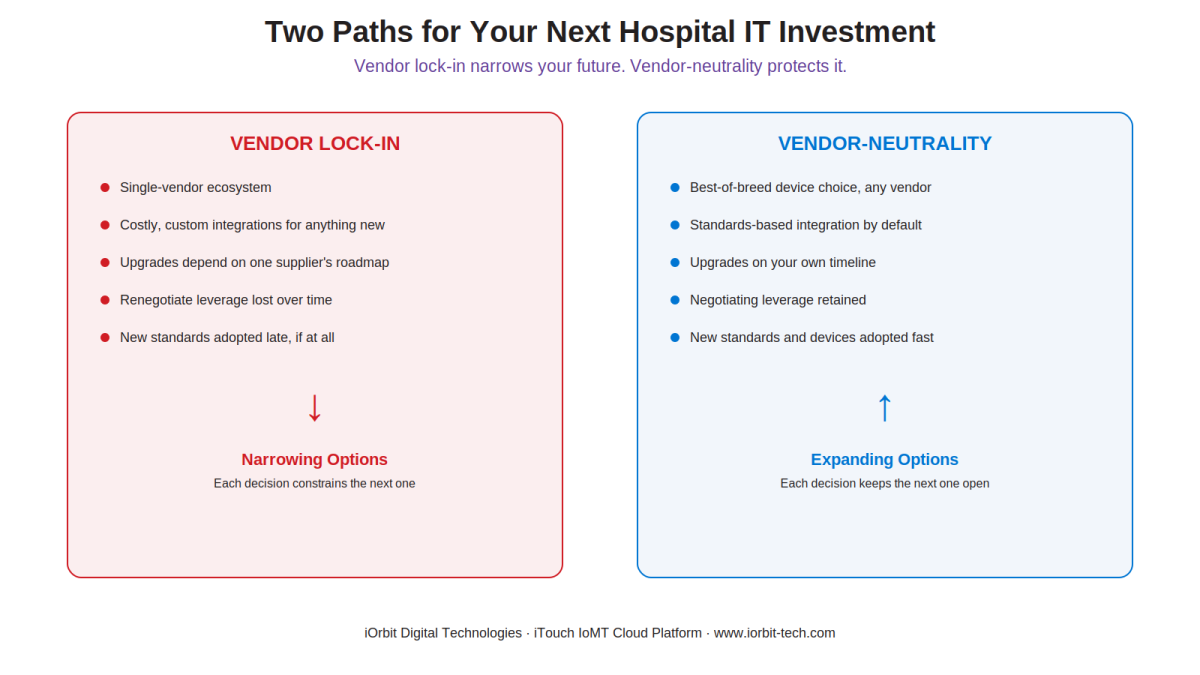
Lock-in rarely looks like a mistake at the time of purchase. It usually looks like convenience - one vendor, one contract, one relationship to manage. The cost shows up later, in the form of narrowing options:
- Upgrade paths controlled by someone else. Your roadmap becomes dependent on the vendor's roadmap, not your organization's actual needs.
- Diminishing negotiating power. Once switching costs are high enough, pricing leverage shifts entirely to the incumbent vendor.
- Slower adoption of new standards. A vendor with no competitive pressure has less incentive to move quickly on emerging interoperability standards or device categories.
- Stranded assets. Perfectly functional equipment gets retired early simply because it can't integrate with whatever comes next.
A March 2026 CHIME Foundation survey of health system CIOs found that only 16% said their core EHR supports vendor-agnostic interoperability, and 42% cited vendor unwillingness and delays as a barrier.
What Vendor-Neutrality Actually Protects
Choosing a device-agnostic platform isn't about avoiding any particular vendor - it's about preserving your organization's ability to choose. Vendor-neutrality protects four things specifically:
1: Freedom of choice.
Buy the best device for each clinical need, from any manufacturer, without integration penalties.
2: Cost control.
Competitive pressure between vendors keeps pricing honest, since switching remains a realistic option.
3: Adaptability.
New device categories, standards, or care models can be adopted as they emerge, not years after they've become mainstream.
4: Longevity of investment.
A platform built on open standards keeps working with new technology instead of becoming obsolete alongside one vendor's product line.
Notice that none of these four benefits are about any single cost-saving trick. They're about optionality - the ability to make a different, better choice later, if circumstances change. That's what future-proofing actually means: not predicting the future correctly, but staying flexible enough to adapt to whatever it turns out to be.
Calculating the Real ROI of Vendor-Neutrality
Cost-benefit conversations about vendor-neutrality often focus only on upfront integration costs. The fuller picture includes:
- Avoided switching costs. The cost never incurred because a future device or system integrates without a custom project.
- Negotiating leverage retained. Multi-vendor flexibility keeps pricing conversations competitive year after year.
- Extended asset lifespan. Equipment stays useful longer when it isn't tied to one ecosystem's support lifecycle.
- Reduced risk exposure. If a vendor is acquired, discontinues a product line, or changes strategy, a vendor-neutral hospital isn't stranded.
How iTouch Delivers Vendor-Neutrality
The iTouch IoMT Cloud Platform is built as a vendor-neutral hub from the ground up - supporting multi-vendor device integration, standards-based connectivity through HL7 and FHIR, and flexible deployment across cloud, hybrid, and on-premises environments. It's designed so that every future purchasing decision stays open, rather than being pre-determined by today's platform choice.
Future-proofing a hospital IT investment isn't about picking the technology that looks best today - it's about preserving the freedom to adapt as needs, standards, and vendors change. Vendor-neutrality is what makes that freedom possible. Every dollar spent on a vendor-neutral foundation is a dollar that keeps working for your organization, not against it, for years to come.
Protect Your Next Decision
Before your next major IT investment, ask whether it expands your future options or narrows them. Explore how the iTouch IoMT Cloud Platform is built for vendor-neutrality from the ground up.