

Medical Device Cybersecurity 2026: Proven Security by Design Guide
June 30, 2026
From ICU to Home Care: How iTouch Enables Continuous Remote Patient Monitoring
July 18, 2026Medical Device Cybersecurity 2026: Proven Security by Design Guide
June 30, 2026From ICU to Home Care: How iTouch Enables Continuous Remote Patient Monitoring
July 18, 2026
The Future of Connected Care: Why Device-Agnostic Platforms Matter
How a device-agnostic platform ends vendor lock-in and makes multi-vendor device integration simple across hospitals.
A device-agnostic platform is the neutral layer that lets hospitals connect medical devices from any manufacturer through one system, instead of being locked into a single vendor’s ecosystem. It turns fragmented, proprietary data streams into a unified, real-time view of the patient - cutting integration cost, speeding deployment, and future-proofing every technology decision. For connected care to scale, device neutrality is no longer optional; it is the foundation.
Connected care has a simple promise: the right patient data reaches the right clinician at the right moment, wherever care happens. Yet in most hospitals that promise runs into a wall. A patient monitor from one vendor won’t talk to an infusion pump from another. A wearable feeding home-monitoring data lands in a portal the EHR can’t read. Every new device seems to demand its own driver, its own dashboard, and its own costly integration project.
The root cause is rarely the device itself - it is the proprietary, closed architecture that surrounds it. This is where a device-agnostic platform changes the equation. Instead of forcing every device into one manufacturer’s walled garden, it acts as a vendor-neutral hub that speaks to all of them and delivers clean, standardized data to the systems clinicians already use.
What Is a Device-Agnostic Platform?
A device-agnostic platform (also called a vendor-neutral or vendor-agnostic platform) is an Internet of Medical Things (IoMT) layer designed to integrate, translate, and manage data from medical devices regardless of who manufactured them. It does not care whether a signal arrives over Bluetooth, Wi-Fi, a serial cable, or a hospital network - and it does not care whether the device is a bedside ventilator, a smartwatch, or a CT scanner. Its job is to normalize all of that into a single, consistent stream of information.
- Multi-protocol connectivity - the ability to communicate across the many transport and messaging protocols medical devices actually use, from Bluetooth Low Energy to DICOM.
- Device translation and normalization - converting each vendor’s data format into standardized healthcare messages such as HL7 and FHIR so downstream systems can consume them.
- Vendor-neutral management - onboarding, monitoring, and updating devices from any brand through one interface, with no rip-and-replace.
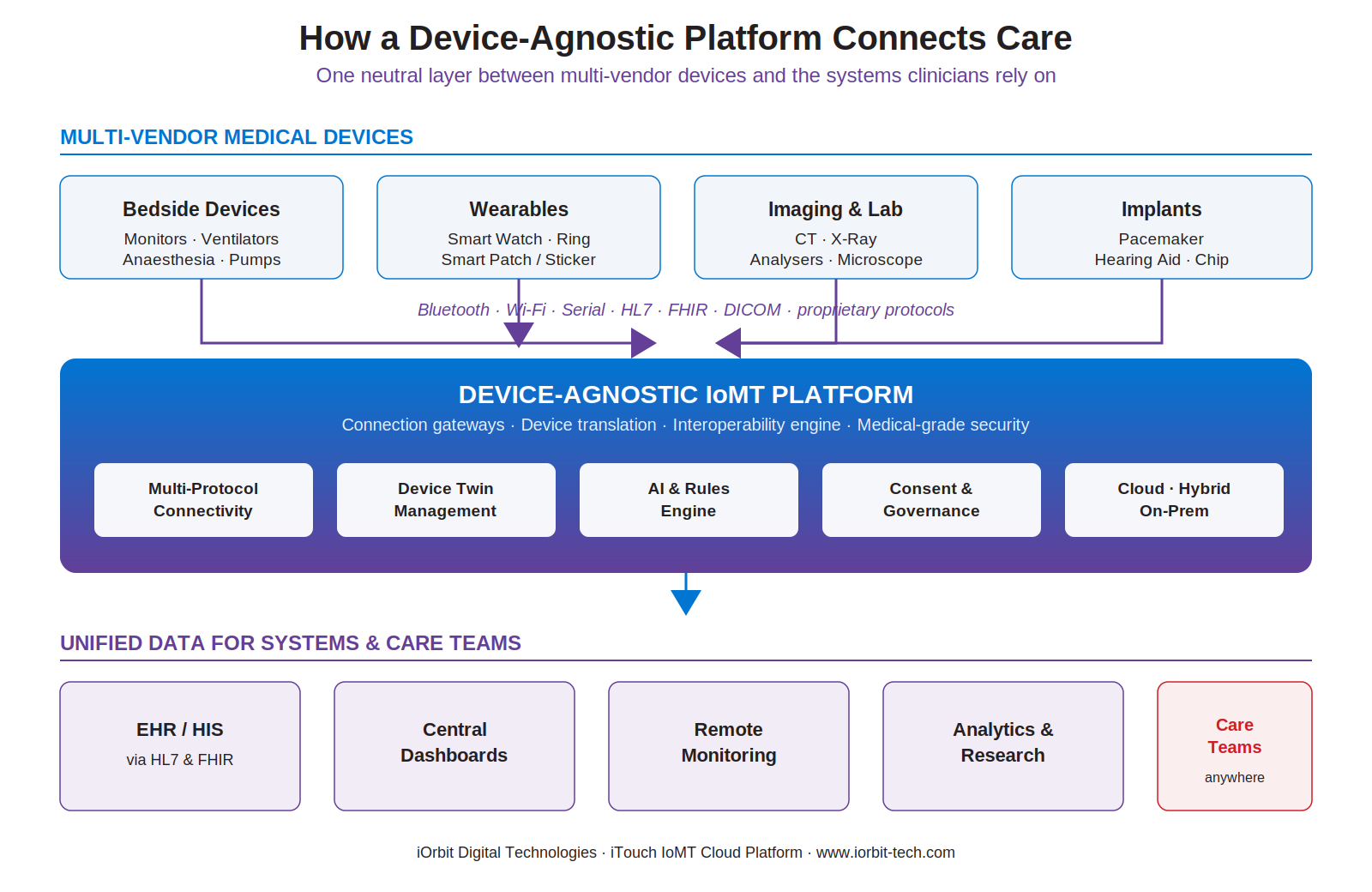
Figure 1 : A device-agnostic platform sits between multi-vendor devices and the systems and teams that depend on their data.
The Real Cost of Vendor Lock-In in Healthcare
Vendor lock-in feels convenient at purchase time -one supplier, one contract, one point of contact. The costs show up later, and they compound:
- Escalating integration bills. Each new device or system becomes a custom project, often priced at a premium because only the incumbent vendor can do it.
- Stranded investments. Perfectly good equipment gets retired early because it can’t be connected to newer systems.
- Data silos and clinical blind spots. When devices can’t share data, clinicians piece together the patient story from multiple screens -slower, and riskier.
- Slower innovation. Adopting a better wearable or analytics tool means renegotiating with, or working around, the locked-in vendor.
For a deeper look at how open integration removes these barriers, see our related article on vendor-agnostic interoperability.
Almost every barrier to connected care -high integration costs, data silos, stalled innovation, painful upgrades -traces back to the same source: devices and systems that were never designed to work with anything outside their own brand. A device-agnostic platform attacks that single root cause.
How Device-Agnostic Platforms Break the Lock-In
Device neutrality is achieved by building on open interoperability standards rather than proprietary interfaces. Three standards do most of the heavy lifting:
- HL7 and FHIR -the messaging and API standards that let clinical data move between devices, platforms, and electronic health records. (HL7 FHIR)
- DICOM -the global standard for medical imaging, so scanners and PACS speak a common language. (DICOM Standard)
- Open APIs and gateways -programmable connection points that let new devices and third-party systems plug in without custom rebuilds.
Regulators increasingly expect this openness. The U.S. FDA publishes dedicated guidance on the safe design of interoperable medical devices, and national health-IT policy under ASTP/ONC continues to push the industry toward standardized, FHIR-based data exchange. Choosing a device-agnostic platform is therefore not just an operational win -it aligns the hospital with the direction regulation is already heading.
7 Ways a Device-Agnostic Platform Powers Connected Care
When the neutral layer is in place, the benefits reach administrators, clinicians, and IT teams alike:
- One unified patient view. Vitals, imaging, and wearable data converge into a single real-time picture instead of scattered screens.
- Faster, cheaper integration. Pre-built connectors and open APIs replace bespoke projects, cutting both time-to-value and cost.
- Freedom of choice. Buy the best device for each clinical need, from any vendor, without integration penalties.
- Care beyond hospital walls. The same platform extends monitoring to step-down units, home care, and telehealth.
- Smarter decisions with AI. Standardized data is the fuel for predictive analytics and early-warning alerts.
- Security and compliance by design. Neutrality does not mean openness to risk -a mature platform embeds medical-grade security and governance.
- Future-proofing. New devices, standards, and deployment models can be adopted without re-architecting the whole system.
iTouch: A Device-Agnostic Platform Built for Connected Care
iOrbit’s iTouch IoMT Cloud Platform is a vendor-agnostic MedTech platform built precisely for this challenge. It is designed to interface seamlessly with a wide range of medical devices -from wearables to patient monitors to imaging systems -so healthcare providers can streamline remote patient monitoring and unify healthcare data while keeping patient information secure.
What makes iTouch device-agnostic in practice:
- Broad multi-protocol support -from Bluetooth to DICOM -with pre-integration for leading global device vendors.
- Standards-based integration with third-party systems through HL7 and FHIR.
- Device translation and device-twin management to onboard and monitor multi-vendor fleets from one place.
- A multi-layered, modular architecture that scales from a single clinic to large hospital networks.
- Flexible deployment across public cloud, private cloud, and on-premises setups.
- Built-in AI tools for intelligent alerts and data-driven clinical decision support.
Because it is secure by design, iTouch treats data privacy and cybersecurity as core requirements -aligning with regional and global healthcare data regulations rather than bolting security on afterward. It is the same foundation behind the shift toward cloud-connected medical devices and the broader move to connected care through IoMT.
Choosing a Device-Agnostic Platform: What to Look For
For hospital administrators and IT leaders evaluating options, a few questions separate a genuinely neutral platform from one that simply claims to be:
- Does it support the protocols and standards your current and future devices use -not just a curated shortlist?
- Can it integrate with your existing EHR/HIS through HL7 and FHIR without custom middleware for every connection?
- Does it scale across sites and deployment models (cloud, hybrid, on-prem) as your network grows?
- Is security and regulatory compliance built into the architecture?
- How quickly can a new device be onboarded -days, or months?
The future of connected care will not be built on any single vendor’s ecosystem -it will be built on neutrality. A device-agnostic platform frees hospitals to choose the best technology, unifies fragmented data into actionable insight, and grows with the organization instead of constraining it. In connected care, device neutrality is the difference between technology that limits you and technology that lasts.
Move Toward Truly Connected Care
Vendor lock-in is a choice -and so is breaking free of it. If your organization is planning its next phase of connected care, a device-agnostic foundation is the decision that makes every later decision easier. Explore how iTouch can unify your multi-vendor devices and simplify integration across your hospital: iOrbit iTouch IoMT Cloud Platform.