Scaling Healthcare Networks: 4 Stages of Smart Growth
September 24, 2026Scaling Healthcare Networks: 4 Stages of Smart Growth
September 24, 2026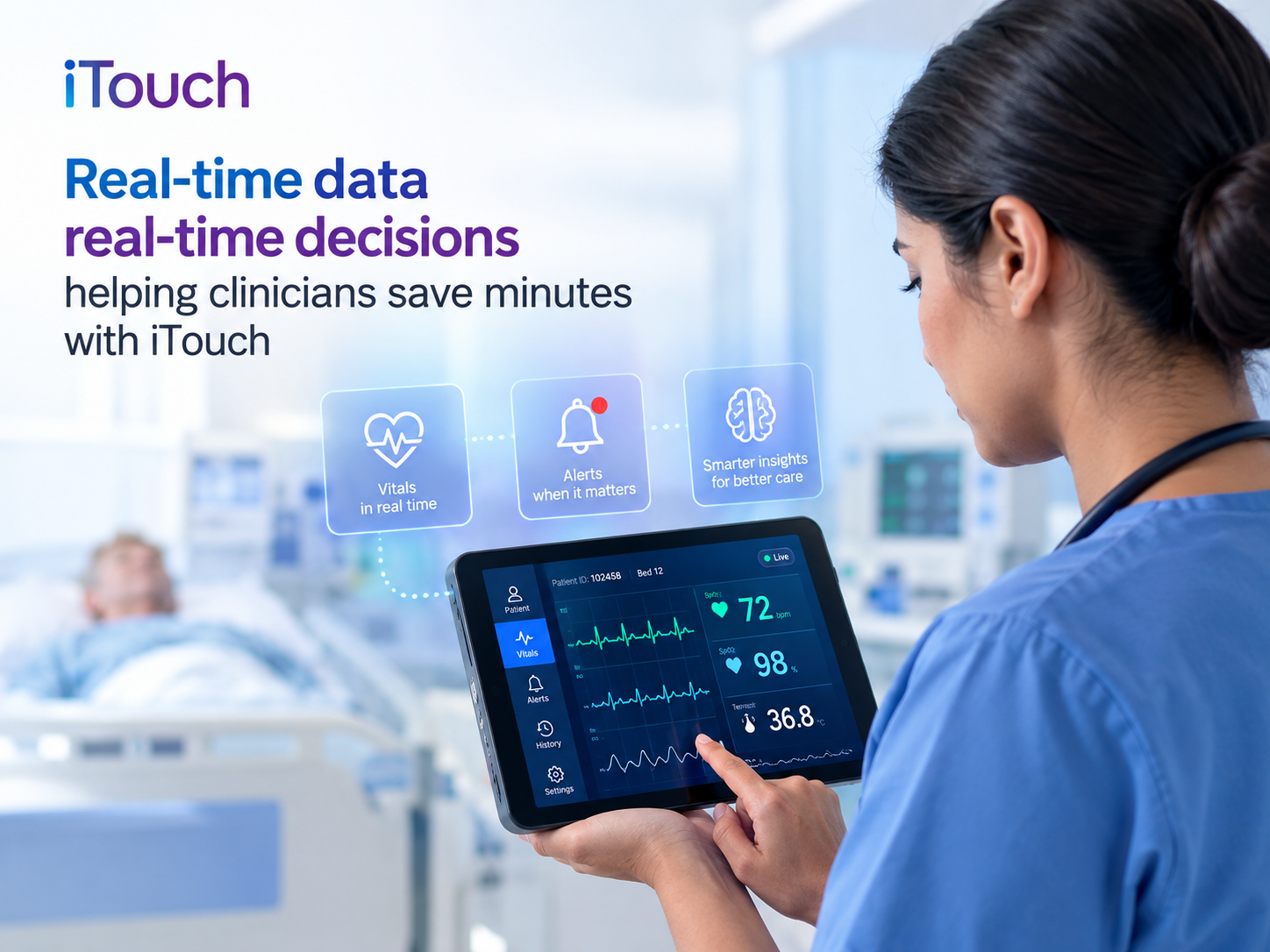
Real-Time Data, Real-Time Decisions: How iTouch Helps Clinicians Save Precious Minutes
Alarms, workflows, and clinical time savings - how shrinking the gap between an event and a decision changes outcomes at the bedside.
In clinical care, the value of data isn't in having it - it's in how fast it reaches the person who can act on it. A vital sign change that takes ten minutes to reach a nurse is far less useful than the same change surfaced in real time. This article looks at how real-time data delivery, powered by iTouch, compresses the gap between an event occurring and a clinician acting on it - and why those saved minutes are often the difference between a routine intervention and an emergency.
Ask any ICU nurse what the most valuable resource on a busy shift is, and the answer is rarely equipment or staffing alone - it's time. Specifically, the time between something changing in a patient's condition and someone finding out about it. That gap, measured in minutes, is where outcomes are won or lost.
This is the core promise of real-time data, real-time decisions: collapsing the distance between an event happening at the bedside and the right person knowing about it, with enough context to act immediately.
Where Minutes Get Lost Today
In many hospitals, the path from a clinical event to a clinical decision still runs through unnecessary delay:
- Manual charting lag. Vitals recorded by hand and entered later mean the data a clinician sees may already be out of date.
- Siloed device displays. A change on one monitor doesn't automatically reach anyone unless someone happens to be watching that specific screen.
- Alert floods. When every parameter change triggers an alarm, clinicians can't tell the urgency from the routine - so response time to genuine emergencies slows down too.
How iTouch Closes the Gap
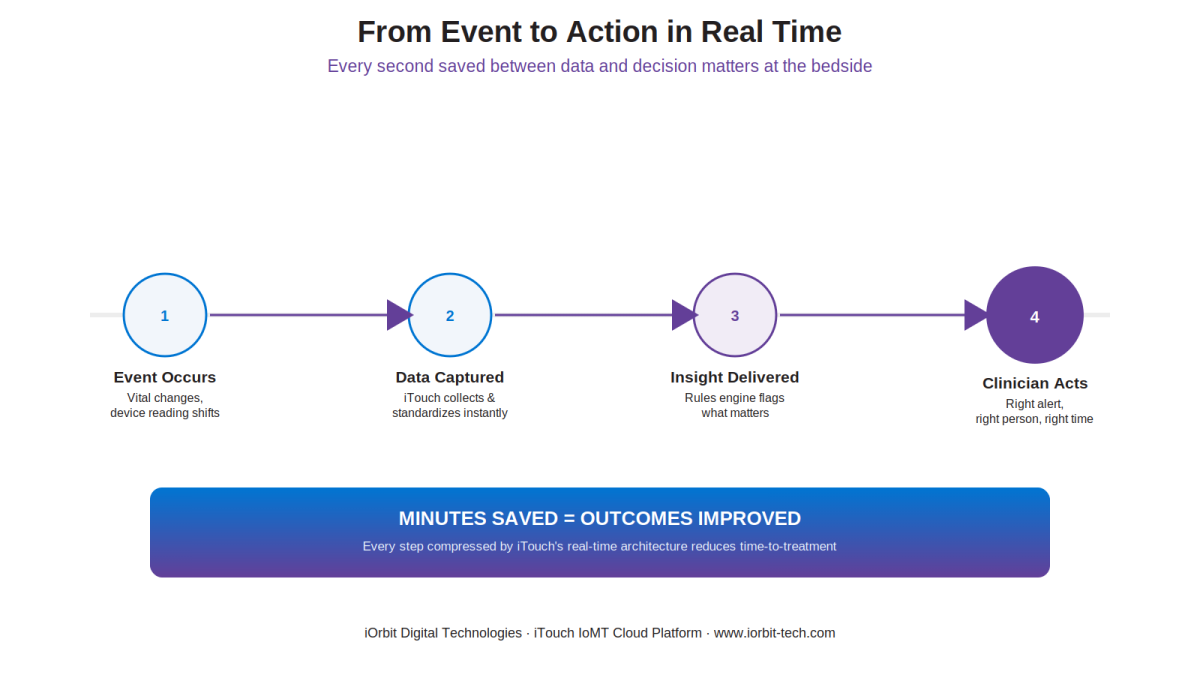
1: Instant Data Capture
The moment a device reading changes - a heart rate spike, a falling oxygen level- iTouch captures it immediately, without waiting for a manual entry or a scheduled sync. Real-time data, real-time decisions start with data that is never stale.
2: Standardization Without Delay
Raw device data is standardized on the fly using HL7 and FHIR, so it's immediately usable by dashboards, alert systems, and the EHR - no batch processing, no lag between capture and usability.
3: Intelligent, Prioritized Alerts
Rather than flooding staff with every fluctuation, iTouch's rules engine filters for clinically meaningful change, so the alerts that do arrive are the ones worth immediate attention - cutting the time clinicians spend triaging their own alarms.
4: Delivery to the Right Person
Real-time insight is only useful if it reaches someone who can act. iTouch routes alerts and updates to the appropriate care team member - bedside nurse, on-call physician, rapid response team - based on severity and context.
Each of these four steps removes a specific source of delay - capture lag, format lag, alert noise, and misrouted information. Individually, each saves seconds. Together, across thousands of events per day in a busy hospital, they add up to a measurably faster path from a clinical change to a clinical response.
Real-World Examples of Time Saved
- Deteriorating patient on a general ward. A subtle multi-parameter trend is flagged and routed to the covering nurse minutes before it would have been caught on the next scheduled round.
- Post-operative recovery monitoring. Real-time vitals let recovery teams catch early signs of complications immediately, rather than at the next check interval.
- Medication administration timing. Real-time infusion pump data helps clinical teams verify dosing and timing without waiting for a manual log update.
- Rapid response activation. Composite early-warning scores calculated in real time can trigger a rapid response team the moment a threshold is crossed, not after a delayed chart review.
Why This Matters Beyond the Bedside
Faster decisions don't just improve individual outcomes - they change how a unit operates. Less time spent chasing information means more time for direct patient care, and fewer preventable escalations means lower costs and shorter stays. This is the same principle behind iTouch's approach to ICU alert management, extended across every care setting the platform touches.
In clinical care, data that arrives late is data that arrives too late. Real-time data, real-time decisions is not a technical nicety - it's what turns a monitoring system into a genuine safety net. By closing the gap between an event and a response, iTouch helps clinicians act in the minutes that matter most, before a manageable change becomes a crisis.
Give Your Clinicians Back Their Minutes
If your teams are losing critical time between data and decisions, it's worth examining where those delays live. Explore how the iTouch IoMT Cloud Platform delivers real-time data, real-time decisions across every unit.