iORBIT Named an IDC Innovator for Vertical AI, SaaS, and Industry Clouds, 2026
July 24, 2026iORBIT Named an IDC Innovator for Vertical AI, SaaS, and Industry Clouds, 2026
July 24, 2026
Healthcare Interoperability Standards: HL7, FHIR, DICOM and How iTouch Makes It Simple
The three standards behind connected care, explained in plain language for the people who run hospitals - not just the engineers who build the systems.
Healthcare runs on data that has to move between systems - but only if those systems speak a common language. That common language is a set of interoperability standards: HL7, FHIR, and DICOM. You don’t need to be an engineer to make good decisions about them; you need to know what each one does and what to expect from a platform that uses them well. This article explains all three in plain terms and shows how iTouch turns these standards into seamless, plug-and-play integration across your hospital.
Healthcare interoperability standards sound complicated the moment a vendor starts talking: HL7, FHIR, DICOM, APIs, integration engines. For a hospital administrator or clinical leader, it can feel like you need a computer science degree just to evaluate the options. You don't
These standards exist for one simple reason: so that data from one system can be understood by another. When they work, a lab result, a vital sign, and an X-ray can all come together into one picture of the patient. When they’re missing or poorly implemented, you get data silos. This guide breaks down the three healthcare interoperability standards that matter most - in language anyone on your team can follow.
What Is Healthcare Interoperability?
Healthcare interoperability is the ability of different systems, devices, and applications to exchange data and actually use it - not just pass files back and forth, but understand each other. Healthcare interoperability standards are the agreed-upon rules that make this possible. Think of them as shared grammar: as long as every system follows the same grammar, they can hold a conversation, even if they were built by different vendors in different decades.
There are three standards you’ll encounter most often. Each solves a different part of the puzzle.
The 3 Standards That Make Interoperability Work
1. HL7 - The Common Language for Clinical Messages
HL7 (Health Level Seven) is the long-established standard for sending clinical messages between systems - a patient is admitted, an order is placed, a lab result is ready. When one system needs to tell another that something happened, HL7 is usually how it says it. Its job, in plain terms: “tell every system what just happened.” It’s the workhorse behind most hospital data exchange today. (HL7)
2. FHIR - The Modern API for Health Data
FHIR (Fast Healthcare Interoperability Resources, pronounced “fire”) is the newer, web-friendly standard from the same organization behind HL7. Instead of only pushing messages, FHIR lets applications request exactly the data they need, the same way a mobile app fetches information from the internet. Its job: “ask for exactly the data you need, on demand.” FHIR is what makes modern apps, patient portals, and AI tools able to plug into hospital data cleanly. (HL7 FHIR)
3. DICOM - The Standard for Medical Imaging
DICOM (Digital Imaging and Communications in Medicine) is the global standard for medical images - CT, MRI, X-ray, ultrasound - and, crucially, the patient information that travels with them. It ensures a scan taken on one machine can be viewed and understood anywhere. Its job: “share the scan, not just the file.” Without DICOM, imaging would be locked inside each device’s software. (DICOM Standard)
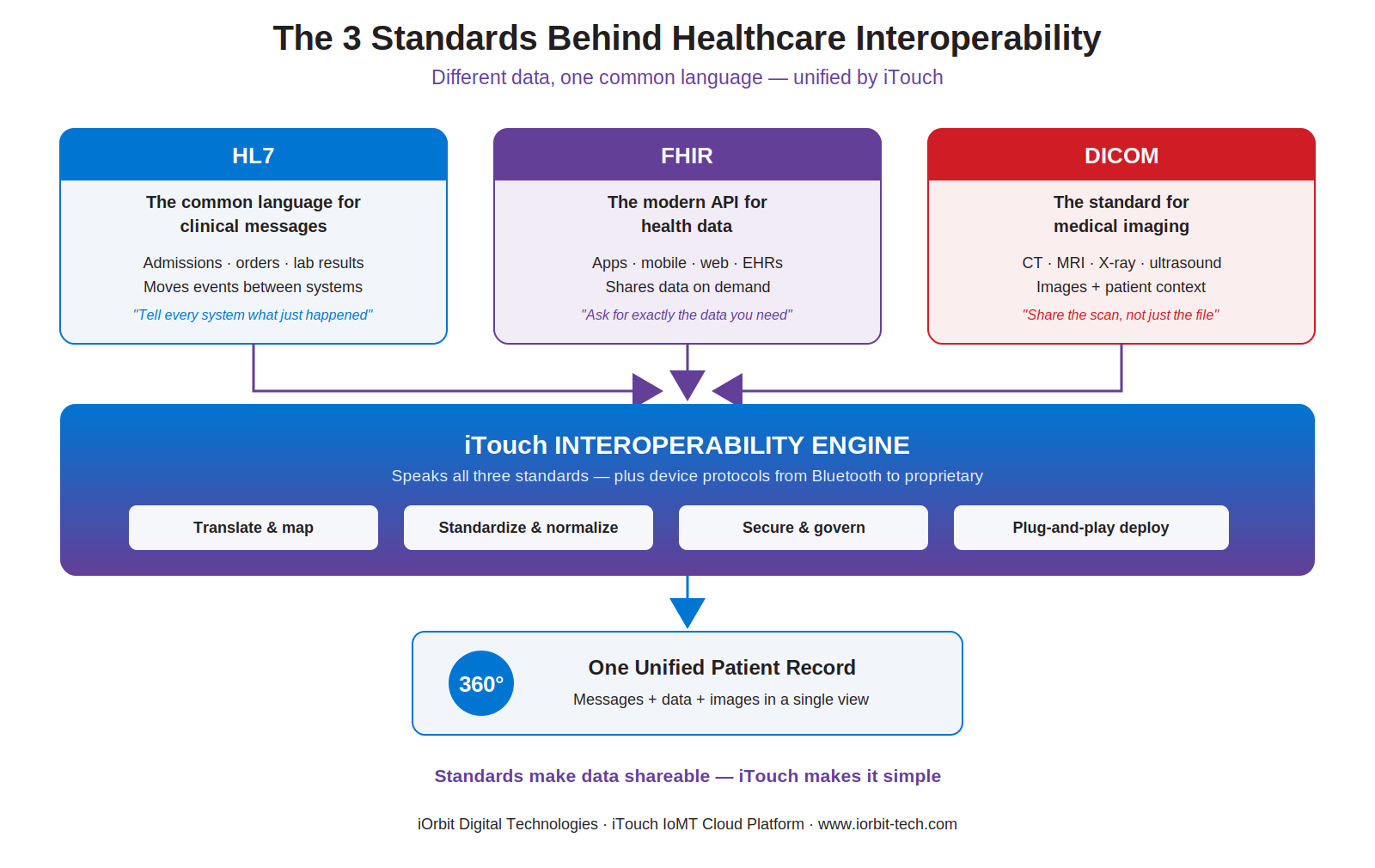
Figure 1: HL7 carries clinical messages, FHIR shares data on demand, and DICOM handles imaging - iTouch speaks all three and unifies them into one patient record.
HL7, FHIR, and DICOM each solve a different problem - messages, on-demand data, and imaging - but they share one purpose: letting systems that were never designed together still work together. Standards are what turn a pile of disconnected systems into a network. The catch is that adopting a standard and implementing it well are two very different things.
Why Standards Alone Aren’t Enough
Here's what vendors rarely explain about healthcare interoperability standards: adopting them and implementing them well are two different things. Two systems can both “support FHIR” and still struggle to connect, because standards leave room for interpretation, versions differ, and older devices may speak only partial or proprietary dialects. In the real world, a hospital runs a mix of modern and legacy systems, each implementing the standards a little differently.
This is exactly the gap a device-agnostic platform is built to close. Rather than hoping every system speaks the standards perfectly, the platform does the translating - mapping each system’s dialect into a clean, consistent stream. Standards make data shareable; a good platform makes it actually flow.
How iTouch Makes Interoperability Simple
Making sense of healthcare interoperability standards is exactly what the iTouch IoMT Cloud Platform is built for. The iTouch IoMT Cloud Platform is designed to turn this complexity into clarity. It speaks all three standards - HL7, FHIR, and DICOM - and also handles the device-level protocols (from Bluetooth to proprietary formats) that standards don't cover, enabling true multi-vendor device integration across the care continuum
What that means in practice:
- Speaks every language. HL7 messages, FHIR APIs, DICOM imaging, and device protocols - all handled by one platform, so systems from different vendors connect without custom bridges for each pair.
- Translates automatically. iTouch maps and normalizes each system’s dialect, so a lab result, a vital, and a scan land in one consistent record.
- Plug-and-play deployment. Built to deploy quickly across cloud, hybrid, or on-premises setups, without ripping out what already works.
- Secure and compliant by design. Interoperability never comes at the cost of privacy - iTouch is built to align with regulations such as HIPAA and GDPR.
- One unified view. he end result is a single, real-time picture of the patient that clinicians and systems can rely on.
What This Means for Administrators
You don’t need to master the technical detail of HL7, FHIR, or DICOM. You do need to ask the right questions when evaluating any system or platform:
- Does it support all three major standards - HL7, FHIR, and DICOM - not just one?
- Can it handle our legacy systems and multi-vendor devices, or only modern, standards-perfect ones?
- How quickly can a new system or device be connected - and who does the integration work?
- Is data kept secure and compliant (HIPAA, GDPR) throughout?
HL7, FHIR, and DICOM are the three standards that let healthcare systems share clinical messages, data, and imaging. They make interoperability possible - but not automatic. The real value comes from a platform that speaks all of them fluently, translates the messy real-world differences between systems, and keeps everything secure. That’s how iTouch turns healthcare interoperability from a technical headache into a simple, working reality.
Make Interoperability Simple
You shouldn’t need an engineering team to connect your hospital’s systems. If you’re ready to turn interoperability standards into seamless, secure integration, explore how the iTouch IoMT Cloud Platform makes multi-vendor connection simple - or learn more about iOrbit’s approach to unified healthcare data management.