Healthcare Interoperability Standards: HL7, FHIR, DICOM and How iTouch Makes It Simple
July 28, 2026
The Pebble: Fall Detection Wearable Design for Everyday Independence
September 1, 2026Healthcare Interoperability Standards: HL7, FHIR, DICOM and How iTouch Makes It Simple
July 28, 2026The Pebble: Fall Detection Wearable Design for Everyday Independence
September 1, 2026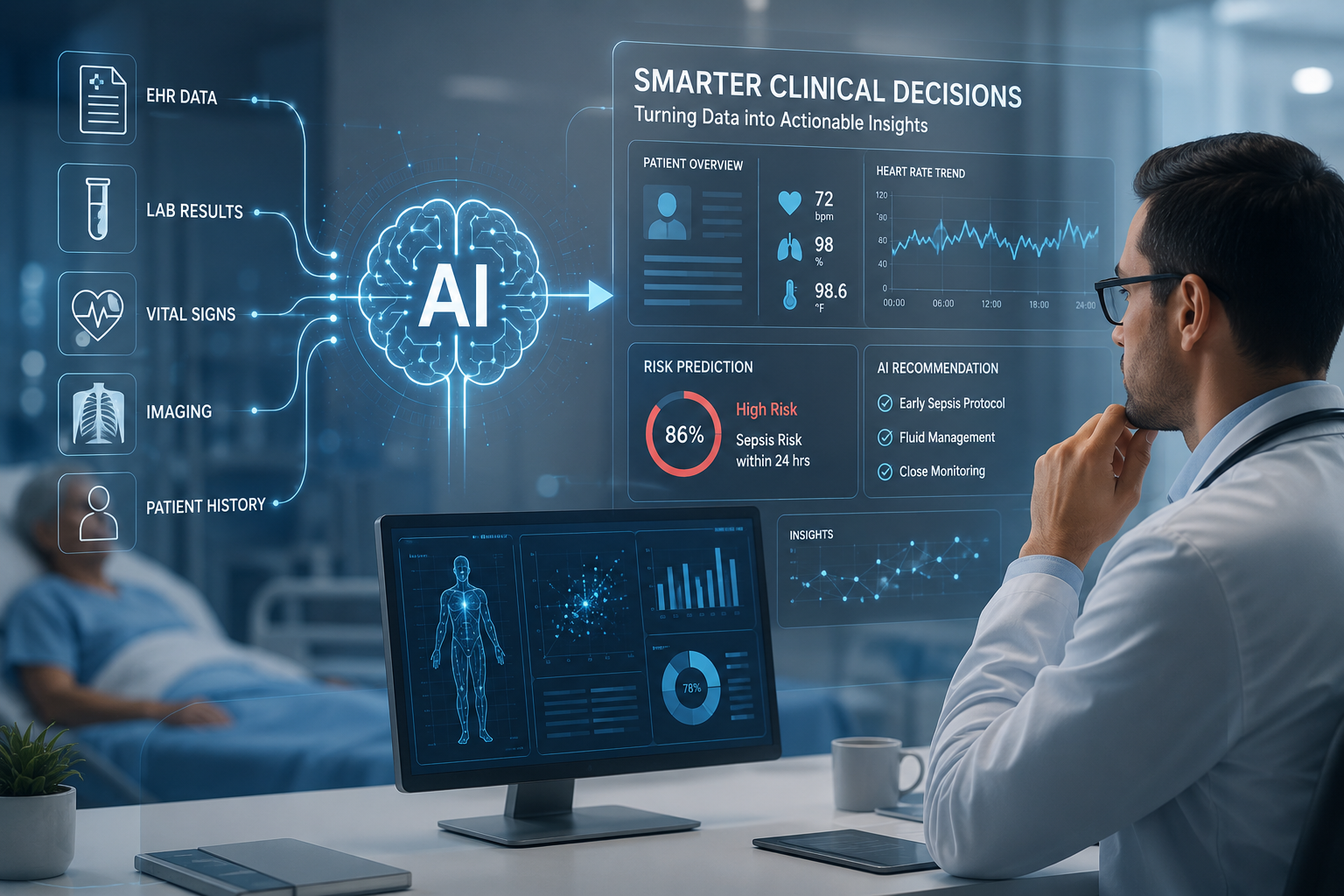
Smarter Clinical Decisions with AI: Turning Data into Actionable Insights
How iTouch's AI module uses predictive analytics and early-warning scoring to help clinicians detect, decide, and act before a crisis happens.
Hospitals generate an enormous volume of clinical data every second, but data alone does not save patients - insight does. iTouch's built-in AI module bridges that gap: it applies pattern recognition, early-warning scoring, and predictive analytics to streaming device data so clinicians see what matters, when it matters. This article explains how AI turns raw data into actionable clinical insights, walks through the real-world use cases that benefit most, and shows how iTouch makes it practical for hospitals of every size.
AI in clinical decision-making is changing what happens in the seconds after a nurse checks a patient's vitals: blood pressure, oxygen saturation, respiratory rate, heart rate. At the same time, alerts fire from another bed, a lab result arrives in the EHR, and a physician messages for an update. She is not short on data - she is drowning in it. What she needs is not more numbers. She needs to know: do these numbers mean stability, or early deterioration? Should I act now, or continue to monitor?
This is the core problem AI in clinical decision-making is built to solve. Not replacing the clinician's judgment, but sharpening it - by transforming a flood of raw data into focused, actionable clinical insights at the moment they are needed. iOrbit's approach to AI in healthcare embeds this intelligence directly into the iTouch platform so it works where the data already lives.
Why Data Alone Is Not Enough
Modern hospitals collect more clinical data than ever: continuous vitals from bedside monitors, wearable streams from home patients, lab panels, imaging, medication records, and infusion rates - all flowing in real time. The paradox is that more data often makes decisions harder, not easier, for three reasons:
- Volume overload. When everything is flagged, nothing stands out. Clinicians face hundreds of alerts per shift, the vast majority of which are clinically irrelevant - a problem known as alarm fatigue.
- Context is missing. A single vital sign in isolation says very little. It is the combination of parameters, trends, and patient history that reveals a story - and stitching that together manually takes time a busy ward does not have.
- Insight comes too late. By the time a human spots a subtle multi-parameter trend, the window for early intervention may already be closing.
For a deeper look at how raw device data becomes meaningful, see our companion article on transforming device metrics into actionable clinical insights.
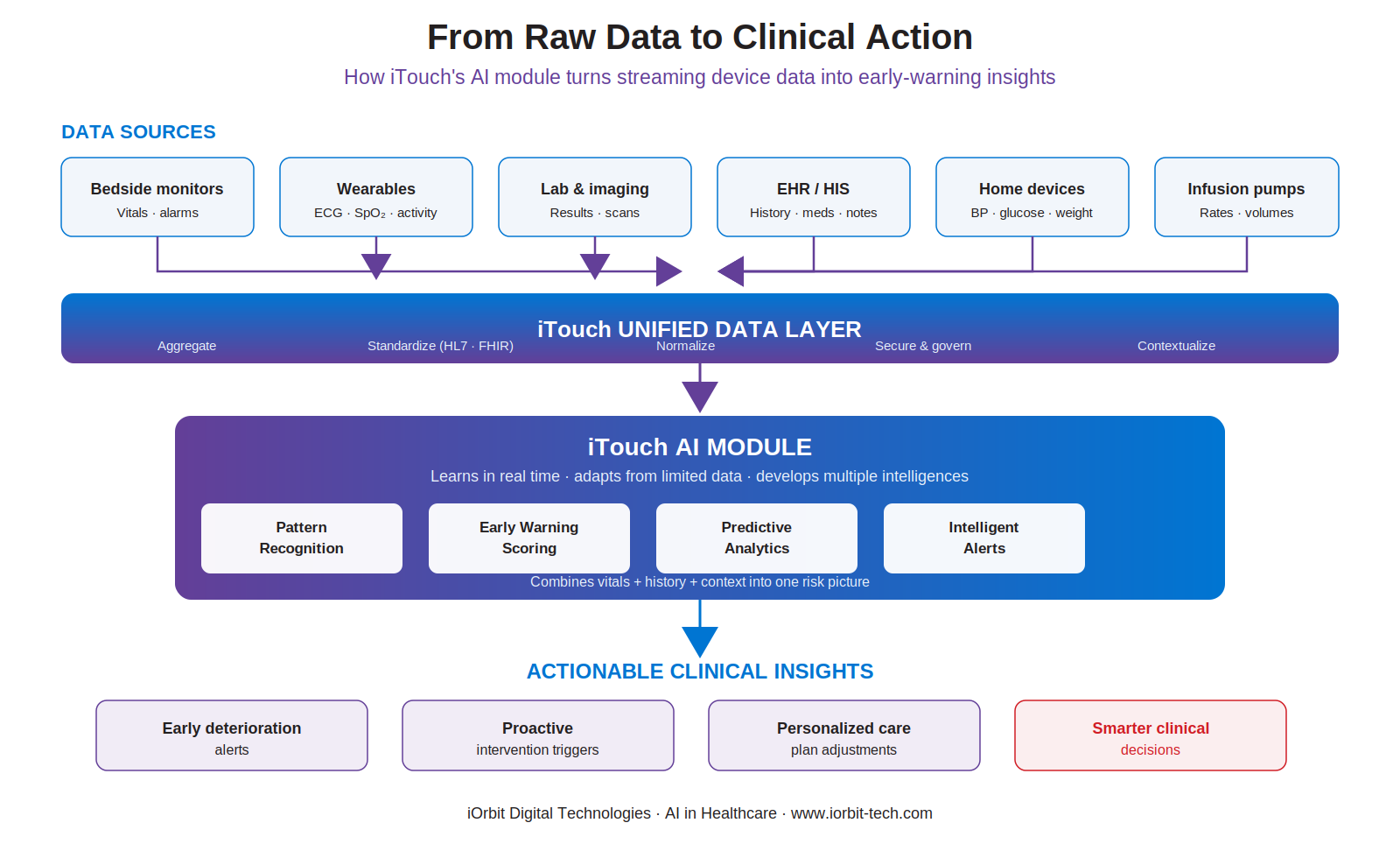
Figure 1: iTouch's AI module sits between unified data and clinical action - applying pattern recognition, early-warning scoring, and predictive analytics.
How iTouch Powers AI in Clinical Decision-Making
AI capabilities are embedded directly into the iTouch IoMT Cloud Platform, not bolted on as a separate product. That means the intelligence operates on the same data stream the platform already collects, standardizes, and secures - no additional data pipeline required. The AI module works in four layers:
1. Pattern Recognition
The module continuously scans incoming data - vitals, lab values, device telemetry - looking for patterns that correlate with known clinical events. Unlike static threshold alarms that fire when a single number crosses a line, pattern recognition looks at combinations: a gradually rising heart rate paired with a slowly falling blood pressure and a subtle change in respiratory pattern may signal early sepsis long before any one parameter trips an alarm on its own.
2. Early-Warning Scoring
iTouch uses a vital-sign-based early-warning scoring system that combines multiple parameters into a single, composite risk score. Instead of forcing the nurse to mentally weigh six different numbers, the system does the math and surfaces one clear signal: this patient is stable, or this patient is trending toward trouble. This is particularly effective in ICU alert management and step-down wards, where catching deterioration early is the difference between a proactive intervention and a code blue.
3. Predictive Analytics
Beyond recognizing what is happening now, the AI module uses historical and real-time data to anticipate what is likely to happen next. Predictive analytics can flag patients at elevated risk of readmission, identify early signs of cardiac events in continuous ECG monitoring, or highlight trends in chronic-disease patients that suggest a therapy adjustment is needed - all before the clinical situation becomes urgent.
4. Intelligent Alerts
The final layer is what reaches the clinician: alerts that are context-aware, priority-ranked, and clinically meaningful. Instead of every threshold breach sounding the same alarm, intelligent alerts distinguish between noise and signal - reducing false positives, cutting through alarm fatigue, and delivering the right information to the right person at the right time.
Each of these four layers solves one piece of the data-to-insight problem. Pattern recognition finds what matters in the noise. Early-warning scoring distills complexity into clarity. Predictive analytics looks ahead. And intelligent alerts deliver the right signal at the right moment. Together, they turn streaming data into a clinical decision advantage - which is the whole point of AI in healthcare.
Real-World Use Cases for AI-Driven Clinical Insights
The value of iTouch's AI module is not theoretical - it maps directly to the scenarios where early detection changes outcomes:
- Early sepsis detection. Multi-parameter pattern recognition flags subtle combinations of vital-sign changes that precede sepsis, enabling intervention hours earlier than threshold-based alarms.
- ICU deterioration alerts. Early-warning scores continuously track patient acuity so care teams are notified at the first sign of decline, not after a crash.
- Post-discharge readmission risk. Predictive models identify patients most likely to return, allowing targeted follow-up and remote monitoring to break the readmission cycle.
- Cardiac event prediction. Continuous ECG analytics - such as those powered by the iECG Patch - detect arrhythmia patterns and QT/QTc changes that signal emerging risk.
- Chronic disease trend analysis. Long-term monitoring of conditions like heart failure, COPD, and diabetes surfaces gradual physiological drifts that trigger proactive care-plan adjustments.
What Makes iTouch's AI Different
Not all clinical AI is built the same. Several design choices distinguish iTouch's approach:
- Learns in real time, from limited data. Unlike conventional models that need massive pre-training datasets, iTouch's AI extracts insights from smaller inputs and improves continuously with use - practical for varied healthcare settings.
- Multiple intelligences from diverse sources. The module integrates and correlates vitals, historical records, and contextual inputs to develop layered intelligence, adapting in real time to match specific clinical scenarios.
- Built into the platform, not bolted on. Because AI sits inside iTouch, it operates on already-unified, standardized data - no additional data pipeline, integration project, or third-party tool required.
- Secure and governed. All AI processing respects the same medical-grade security, consent, and compliance framework (HIPAA, GDPR) that governs the rest of the platform.
Regulators are moving in step with this shift: the FDA's AI/ML-Based Software as a Medical Device framework now governs how AI-enabled clinical tools are developed, validated, and monitored throughout their lifecycle.
Data saves lives - but only when it becomes insight at the right moment. iTouch's AI module transforms streaming clinical data into early-warning scores, predictive risk flags, and intelligent alerts that help clinicians detect problems earlier, decide faster, and intervene before a manageable trend becomes a crisis. In connected care, AI is not a replacement for clinical judgment; it is the tool that makes sure judgment is always informed.
Put AI to Work for Your Care Teams
If your organization is ready to move from reactive alarms to proactive, AI-driven insights, explore how iOrbit approaches AI in healthcare and see the iTouch IoMT Cloud Platform in action.