

Smarter Clinical Decisions with AI: Turning Data into Actionable Insights
August 6, 2026
Non-Contact Infrared Thermometer Design for Rapid Temperature Screening
September 3, 2026Smarter Clinical Decisions with AI: Turning Data into Actionable Insights
August 6, 2026Non-Contact Infrared Thermometer Design for Rapid Temperature Screening
September 3, 2026The Pebble: Fall Detection Wearable Design for Everyday Independence
About Client
A healthcare technology company developing elderly care solutions for independent living and assisted care environments. The client works with home care providers and assisted living operators across residential and facility settings, and its product direction is shaped by a recurring observation from the field: safety technology only helps when the person is willing to keep it on. Their initiatives are driven by human-centered medical product design aimed at improving both safety outcomes and day-to-day quality of life.
Client's Challenge
A healthcare technology company developing elderly care solutions for independent living and assisted care environments. The client works with home care providers and assisted living operators across residential and facility settings, and its product direction is shaped by a recurring observation from the field: safety technology only helps when the person is willing to keep it on. Their initiatives are driven by human-centered medical product design aimed at improving both safety outcomes and day-to-day quality of life.
The obstacle in this project was never the sensing. It was adoption. Reliable detection algorithms already existed. What did not exist was a device that people would consistently choose to wear.
The challenges with existing fall detection devices were:
- Bulky designs with a noticeable medical appearance
- Low user acceptance for continuous everyday wear
- Limited space for integrating electronics, battery, and wireless communication
- Difficulty balancing compact size, comfort, and functionality
- Need for intuitive access to a manual SOS button
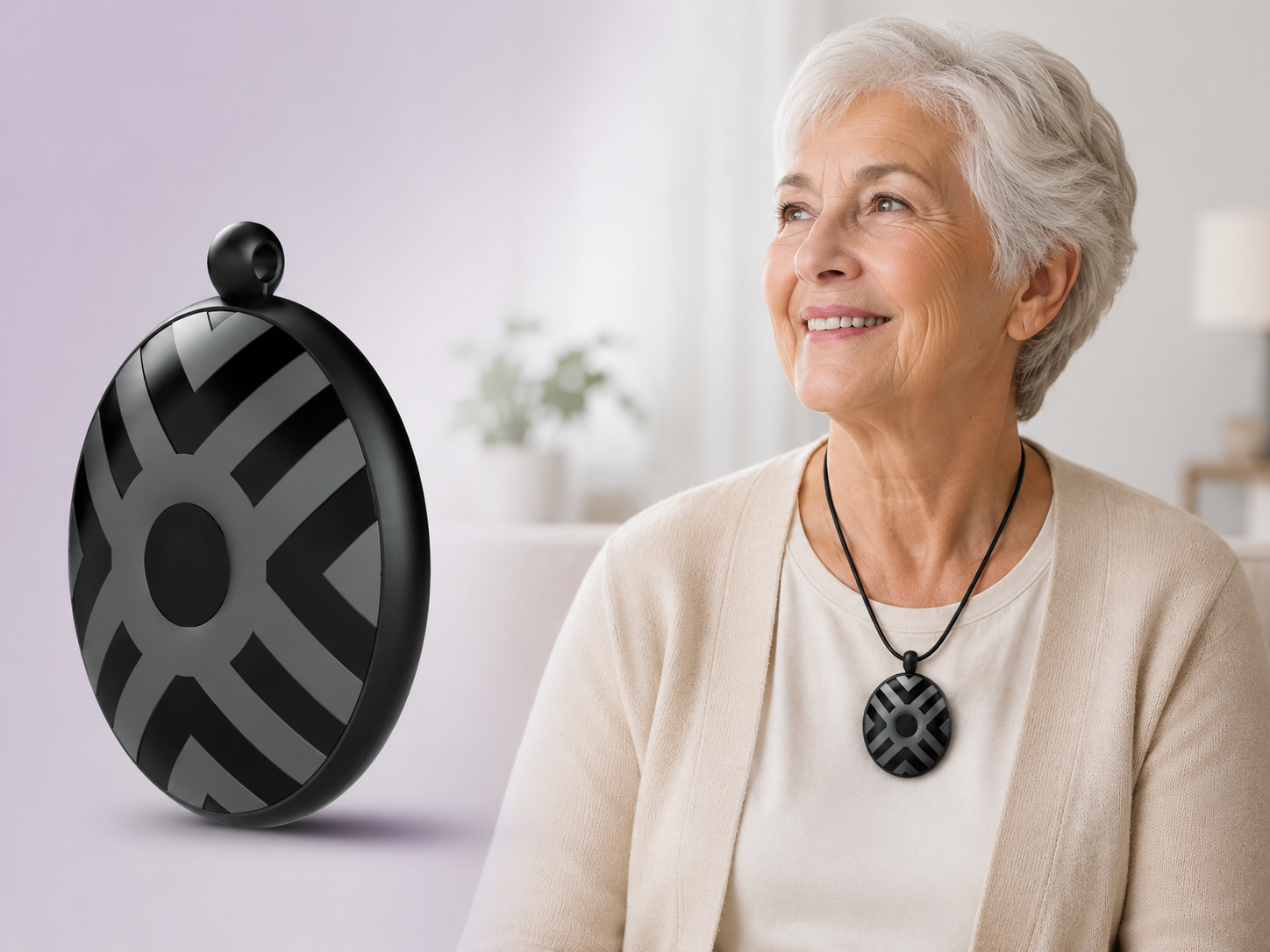
This called for a compact wearable pendant that delivers reliable fall detection and emergency response while maintaining a comfortable, lifestyle-oriented design suitable for everyday use.
Design Focus
The project scope covered industrial design, mechanical design, and product prototyping, delivering an end-to-end wearable product development solution.
- Industrial Design
- Mechanical Design
- Product Prototyping
iORBIT Solution Approach
iOrbit adopted a user-centric industrial design approach, balancing engineering constraints against everyday usability. The governing principle was fixed at the start of the project: if the pendant is not worn, nothing else about it matters. Every subsequent trade-off was resolved against that single test.
Wearability as the Primary Design Constraint
Wearability is often treated as a finishing consideration, applied once the electronics are settled. Here it was defined as a hard requirement that the internal architecture had to accommodate, not the other way round. The outer form was developed first around how a pendant actually hangs and moves against the body, and the component layout was then solved inside that envelope.
Design priorities:
- Compact neck-worn pendant with minimal visual bulk
- Curved ergonomic profile for comfortable all-day wear
- Efficient packaging of sensors, electronics, battery, and wireless communication
- Intuitive SOS button with protection against accidental activation
System Architecture and Component Packaging
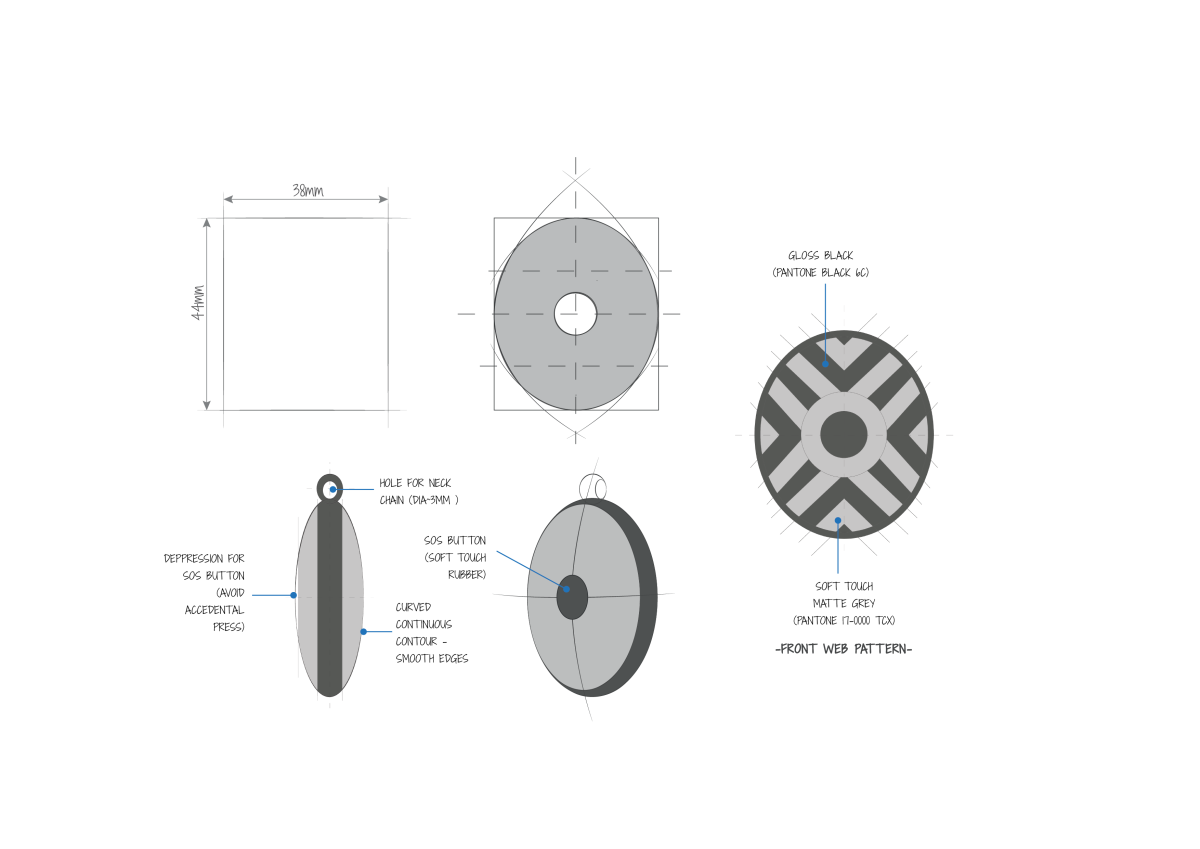
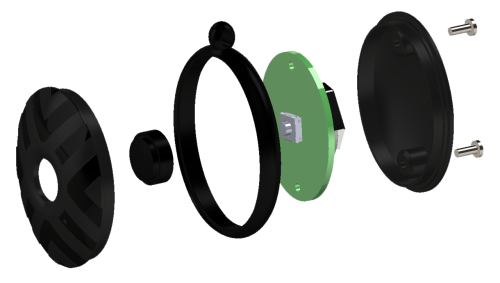
A three-axis IMU streams continuous motion data to a low-power microcontroller running the fall detection algorithm, which combines impact signature, orientation change and post-event dwell before classifying an event as a fall. The recessed SOS button sits alongside it as a parallel manual input, so the wearer can raise an alert whether or not the algorithm fires.
When either path triggers, the wireless module sends an encrypted alert to a paired smartphone or home hub. The gateway adds location context and applies a short cancel window, which reduces false escalations, before notifying the emergency contact, the family caregiver and the care facility dashboard. Event history accumulates in the background and supports longer-term risk review rather than only incident response.
The packaging challenge was fitting all of that into a volume small enough to disappear under everyday clothing. Mechanical design worked the internal layout around the curved outer profile, which meant resolving board shape, battery footprint and antenna clearance against a geometry that had already been fixed by comfort requirements.
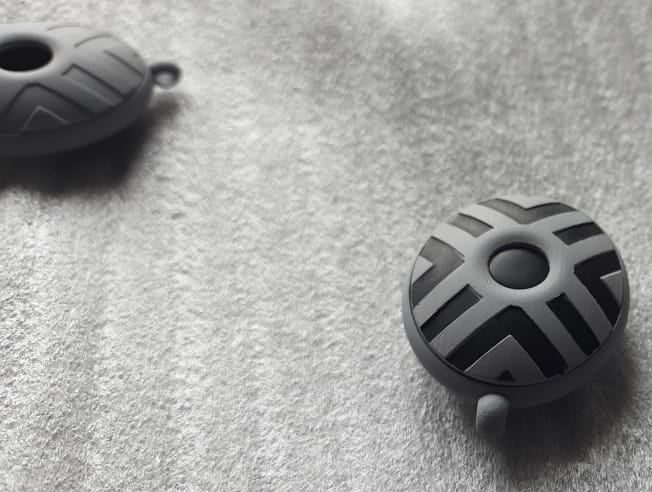
CMF: Designing Away the Medical Look
Colour, material and finish decisions did more for adoption than any single mechanical change. A device reads as medical or as an accessory long before anyone evaluates its function, and that first read determines whether it goes on in the morning.
Design highlights:
- Soft-touch matte finish for improved grip and comfort
- Gloss black accents for a premium appearance
- Minimalist styling that blends naturally with everyday clothing
- Lightweight lanyard for comfortable everyday wear INLINE IMAGE INLINE-01 — CMF and finish detail. Place after the bullet list above.
Designing the SOS Button Against Accidental Activation
A manual SOS control has two failure modes that pull in opposite directions. Make it too accessible and it fires when the wearer leans against a chair back or a seatbelt. Make it too guarded and it cannot be found by someone who has just fallen and is not looking at the device.
The resolution was geometric rather than electronic. The button was recessed below the surrounding surface so incidental contact cannot depress it, the actuation force was tuned to sit above accidental pressure but within comfortable reach of reduced hand strength, and the housing was shaped so the button is not the first surface a hand lands on when gripping the pendant. The recess also gives a tactile edge that can be located by touch alone.
Prototyping and Design Validation
Physical prototypes were used to test what CAD cannot show: how the pendant hangs at rest, how it sits and shifts against the chest during walking and bending, whether the lanyard length keeps it accessible without making it swing, and whether the SOS button can be located without looking. Successive prototype rounds refined the profile curvature, the mass distribution and the button recess depth.
This is the part of wearable product development that cannot be shortcut. Comfort claims that hold up in a CAD review routinely fail on the first hour of real wear.
The Outcome
This project demonstrates how thoughtful industrial design can improve both user acceptance and personal safety for elderly individuals.
The final solution delivers:
- Compact and lightweight neck-worn wearable
- Automatic fall detection with emergency alert capability
- Comfortable, discreet design for consistent everyday use
- Improved confidence, independence, and peace of mind
Conclusion
Through a user-centred industrial design approach, iOrbit delivered a fall detection wearable in which the form supports the safety function rather than undermining it. By treating wearability as the primary constraint and resolving the electronics, the mechanical layout and the CMF around it, the pendant achieves reliable detection and emergency response in a device people are willing to wear continuously.
For the client, the outcome was a product positioned to succeed on the metric that actually governs elder-care wearables: not detection accuracy in a lab, but daily wear rate in a home.