
7 Key Women’s Health Issues in India: PCOS, Fertility, Menopause & Daily Wellness
April 16, 2026
Medical Device Cybersecurity 2026: Proven Security by Design Guide
June 30, 20267 Key Women’s Health Issues in India: PCOS, Fertility, Menopause & Daily Wellness
April 16, 2026Medical Device Cybersecurity 2026: Proven Security by Design Guide
June 30, 2026
Connected Care Through IoMT: The Future of Healthcare Innovation
How connected medical devices, software, and data systems are reshaping hospital, homecare, and preventive healthcare
Introduction
Healthcare is undergoing one of the most significant transformations in its history. For decades, care has been episodic - patients visited a clinic, received a diagnosis, and then went home, often disconnected from the very systems meant to keep them well. Today, that model is breaking down. The Internet of Medical Things (IoMT) is replacing it with a continuous, data-rich, patient-centric experience that follows the individual from hospital to home and beyond.
IoMT is driving Healthcare Innovation by bringing together connected medical devices, clinical software, and intelligent data platforms to enable real-time monitoring, faster decision-making, and more efficient care delivery. From wearables tracking heart rhythms to remote ICUs supporting critically ill patients across geographies, IoMT is no longer a buzzword - it is a foundational layer of modern healthcare innovation.
" IoMT is shifting healthcare from episodic treatment to continuous, real-time monitoring and intervention - across every care setting."
1. Where IoMT is Making the Biggest Impact: Application Areas
The reach of IoMT and Healthcare Innovation extends across the entire continuum of care. While the technology stack is similar - sensors, connectivity, cloud platforms, analytics - the clinical value differs dramatically by setting.
Hospital and Acute Care
Inside hospitals, IoMT is powering smart ICUs, connected infusion pumps, networked imaging equipment, and centralized patient monitoring. Clinicians can now track multiple patients across wards from a single command center, with alerts triggered the moment vitals drift out of range.
Remote Patient Monitoring (RPM) and Homecare
Wearables, connected blood pressure cuffs, glucose monitors, and pulse oximeters are turning the patient's home into an extension of the clinic. This is especially powerful for chronic disease management - diabetes, hypertension, COPD, heart failure - where continuous data prevents the small problems that quietly become emergencies.
Tele-ICU and Remote Specialist Care
Tele-ICU platforms allow intensivists to support multiple hospitals from a central hub. Smaller and rural facilities - which often lack 24/7 specialist coverage - can now deliver tertiary-grade critical care, dramatically improving outcomes and reducing transfers.
Preventive and Wellness Care
Beyond treatment, IoMT is fueling preventive medicine. Smart wearables, sleep trackers, and lifestyle devices feed into wellness platforms that flag risk early - long before a patient walks into a doctor's office.
2. Why It Matters: The Real Benefits of Connected Medical Devices
The shift to connected care is not just a technical upgrade - it changes outcomes for patients, clinicians, and health systems alike.
- Continuous, real-time visibility: Vital signs and device data flow into clinical systems instantly, replacing the gaps between scheduled check-ups.
- Faster, smarter clinical decisions: AI-driven analytics on streaming data help clinicians spot deterioration earlier and act before crises occur.
- Better chronic disease management: Patients with long-term conditions stay engaged in their own care, with personalized feedback loops that improve adherence.
- Reduced hospital readmissions: Post-discharge monitoring catches complications early, lowering the costly cycle of repeat admissions.
- Operational efficiency: Automated data capture cuts manual charting, reduces errors, and frees clinicians to focus on patients rather than paperwork.
- Patient empowerment: People gain access to their own health data, encouraging healthier behavior and stronger care partnerships.
3. The Real Challenge: Building IoMT That Actually Works in the Real World
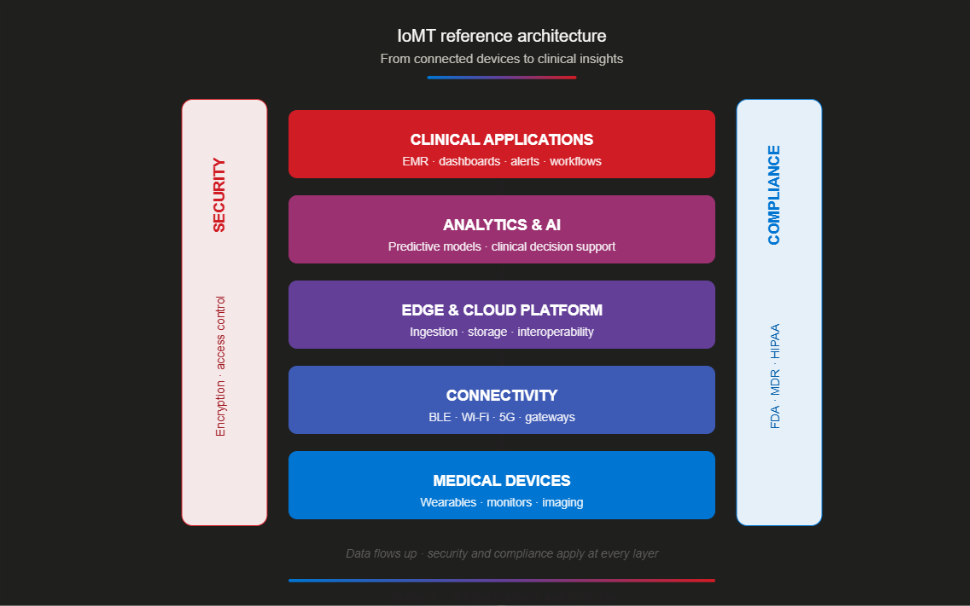
Despite rapid progress, the IoMT industry faces genuine, often underestimated, structural challenges. A device that streams data is not the same as a device that delivers value. Behind every successful deployment sit four hard requirements.
Interoperability
Most hospitals run dozens - sometimes hundreds - of devices and software systems. The vast majority still operate in silos despite vendor claims of being "connected." True interoperability means devices, EMRs, and analytics platforms speak common standards (HL7 FHIR, DICOM, IEEE 11073) and exchange data without expensive custom integration each time.
Security and Data Privacy
Connected medical devices are an attractive target for cyber threats. Encrypted communication, secure firmware updates, role-based access, and continuous vulnerability monitoring are no longer optional - they are foundational. A single breach can compromise patient safety as much as patient privacy.
Regulatory Compliance
IoMT solutions must meet a complex web of regulations: FDA 21 CFR Part 820, MDR in Europe, India's CDSCO guidelines, HIPAA, GDPR, IEC 62304 for medical device software, and ISO 13485 for quality management. Compliance must be engineered in from day one - not bolted on later.
Clinical Reliability
A consumer fitness band can drop a few data points without consequence. A clinical-grade IoMT solution cannot. Devices and platforms must be clinically validated, with proven accuracy, redundancy, and fail-safe behavior under real hospital conditions.
" The next wave of IoMT will not be won by whoever ships the most sensors - it will be won by whoever ships the most trustworthy, integrated, and clinically reliable systems. "
4. Trends Shaping the Next Phase of IoMT
Several forces are accelerating Healthcare Innovation through IoMT adoption and reshaping what "connected care" looks like in practice:
- AI-enabled diagnostics: Machine learning models embedded in IoMT platforms are now flagging arrhythmias, sepsis risk, and imaging anomalies in real time.
- Edge computing in medical devices: More processing is happening on the device itself - reducing latency, protecting data, and enabling action even with intermittent connectivity.
- 5G and low-power connectivity: Faster, more reliable networks are unlocking new use cases like remote surgery support, ambulance telemetry, and high-fidelity wearables.
- Hospital-at-home programs: Health systems are shifting acute care into the patient's home, supported by IoMT-enabled monitoring kits and virtual care teams.
- Open standards momentum: Regulators and large health systems are pushing harder on FHIR adoption and interoperability mandates, eroding vendor lock-in.
5. The Road Ahead: What IoMT Looks Like in 3-5 Years
IoMT is moving from "connected devices" toward fully autonomous, AI-driven clinical ecosystems. Three shifts will define the next phase:
- From monitoring to prediction: Real-time data will trigger predictive interventions with minimal human delay - preventing rather than reacting to deterioration.
- From silos to standards: Interoperability will become regulated rather than optional, forcing vendors to adopt open, plug-and-play architectures.
- From hospital-centric to patient-centric: Continuous remote monitoring will become the default for chronic and post-acute care, with the home as the primary care setting.
Health systems that prepare for this shift now - with the right architecture, partners, and clinical workflows - will lead the next decade of healthcare delivery.
6. The iOrbit Approach: End-to-End, Clinically Reliable IoMT
At iOrbit, we believe the real value of IoMT is unlocked only when devices, platforms, and clinical workflows come together as one cohesive system. That is the foundation of how we work with healthcare partners around the world.
Connected Healthcare Ecosystems
We design and build end-to-end solutions that combine medical devices, embedded software, cloud platforms, and clinical applications - so data flows seamlessly from the patient to the point of decision.
Interoperability and System Integration
Our engineering teams specialize in integrating diverse devices, EMRs, and hospital systems using industry standards like HL7 FHIR, DICOM, and IEEE 11073 - replacing fragmented silos with unified clinical visibility.
Regulatory-Compliant, Clinically Reliable Engineering
Every solution we build is engineered for real-world healthcare environments, aligned with FDA, MDR, IEC 62304, and ISO 13485 frameworks. Quality and compliance are designed in from the first line of code.
Platforms Like iTouch Digital Health
Through platforms such as iTouch, we enable scalable digital health deployments - supporting remote patient monitoring, connected ICUs, chronic care, and preventive wellness with a single integrated foundation.
Conclusion: From Connected Devices to Connected Care
Healthcare Innovation through the Internet of Medical Things is no longer an emerging technology - it is the operating layer of modern healthcare. Real-time monitoring, intelligent analytics, and seamlessly integrated systems are turning every patient touchpoint into an opportunity for better, faster, safer care.
But the future of IoMT will not be defined by how many devices we connect. It will be defined by how reliably, securely, and meaningfully we connect them. Interoperability, security, regulatory compliance, and clinical validation are what separate impressive demos from solutions that genuinely improve lives.
At iOrbit, this is exactly where we focus - building the integrated, trustworthy, end-to-end digital health solutions that healthcare needs today, and that the next decade of patient care will depend on.