

The Pebble: Fall Detection Wearable Design for Everyday Independence
September 1, 2026
Data Security in Digital Health: How iTouch Ensures Compliance and Patient Trust
September 3, 2026The Pebble: Fall Detection Wearable Design for Everyday Independence
September 1, 2026Data Security in Digital Health: How iTouch Ensures Compliance and Patient Trust
September 3, 2026Non-Contact Infrared Thermometer Design for Rapid Temperature Screening
About Client
A healthcare technology company supplying screening and diagnostic equipment to hospitals, clinics and institutional buyers. In early 2020 the client was responding to an urgent and rapidly expanding requirement for non-contact temperature screening across healthcare facilities, workplaces and public venues. Their approach to medical device design services prioritised speed to market without conceding measurement reliability.
Client's Challenge
At the start of the pandemic, every infrared thermometer worth having was imported, expensive, and moving through a supply chain that had effectively stopped. Demand was rising faster than any import route could serve, and lead times on the components themselves were lengthening week by week.
The client needed a device that could be built locally, at volume, beginning immediately. That requirement changed the nature of the design problem: manufacturability was not a downstream consideration to optimise later, it was the governing constraint from the first sketch.
The challenges with the existing market were:
- Dependence on expensive imported infrared thermometers
- Supply chain disruptions affecting product availability
- Need for rapid, high-volume local manufacturing
- Compact design without compromising usability
- Reliable performance using readily available components
This called for a compact, production-ready handheld device engineered around components that could actually be sourced, and around an assembly process that could scale without new tooling or specialist labour.
Design Focus
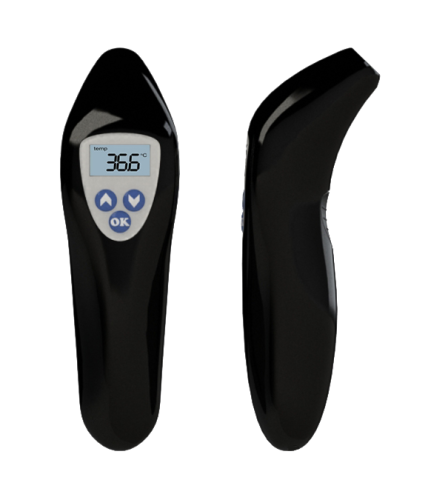
The project scope covered industrial design, mechanical design, and design for manufacturing, delivering a compact and production-ready handheld medical device.
- Industrial Design
- Mechanical Design
- Product Prototyping
iORBIT Solution Approach
iOrbit adopted a pragmatic industrial design approach, balancing ergonomics, manufacturability, and component availability. Where these pulled against each other, component availability won — because a design that cannot be built is not a design, and in early 2020 the difference between an available part and an ideal part was measured in months.
Component Availability as the Starting Point
Conventional practice is to specify the ideal component and then find a supplier. That sequence was inverted here. The bill of materials was constrained first to parts that were verifiably in stock domestically, and the design was then developed around what that list allowed.
This shaped decisions that would normally be made on other grounds. Standard AAA cells were selected over a custom rechargeable pack, which removed a long-lead custom assembly and simplified both certification and field use. The sensor, display and microcontroller were chosen from locally distributed ranges rather than optimised individually.
Design priorities:
- Compact enclosure with optimized internal component layout
- Streamlined architecture for simplified assembly
- Ergonomic grip for comfortable repeated use
- Intuitive trigger and control button placement
System Architecture and Component Packaging
A thermopile infrared sensor takes the non-contact surface reading at a fixed field of view and stand-off distance. The signal is amplified and filtered, with a separate ambient reference measurement feeding the compensation calculation, before a low-power microcontroller applies the calibration curve and computes the displayed temperature.
Output is deliberately redundant. A backlit LCD gives the numeric reading, legible at arm’s length and in low light, while a buzzer and LED indicate whether the reading crosses the configured threshold. In a screening queue the operator often cannot look at the screen for every reading, so the audible and visual indication carries the decision.
Output is deliberately redundant. A backlit LCD gives the numeric reading, legible at arm’s length and in low light, while a buzzer and LED indicate whether the reading crosses the configured threshold. In a screening queue the operator often cannot look at the screen for every reading, so the audible and visual indication carries the decision.
Reducing Part Count
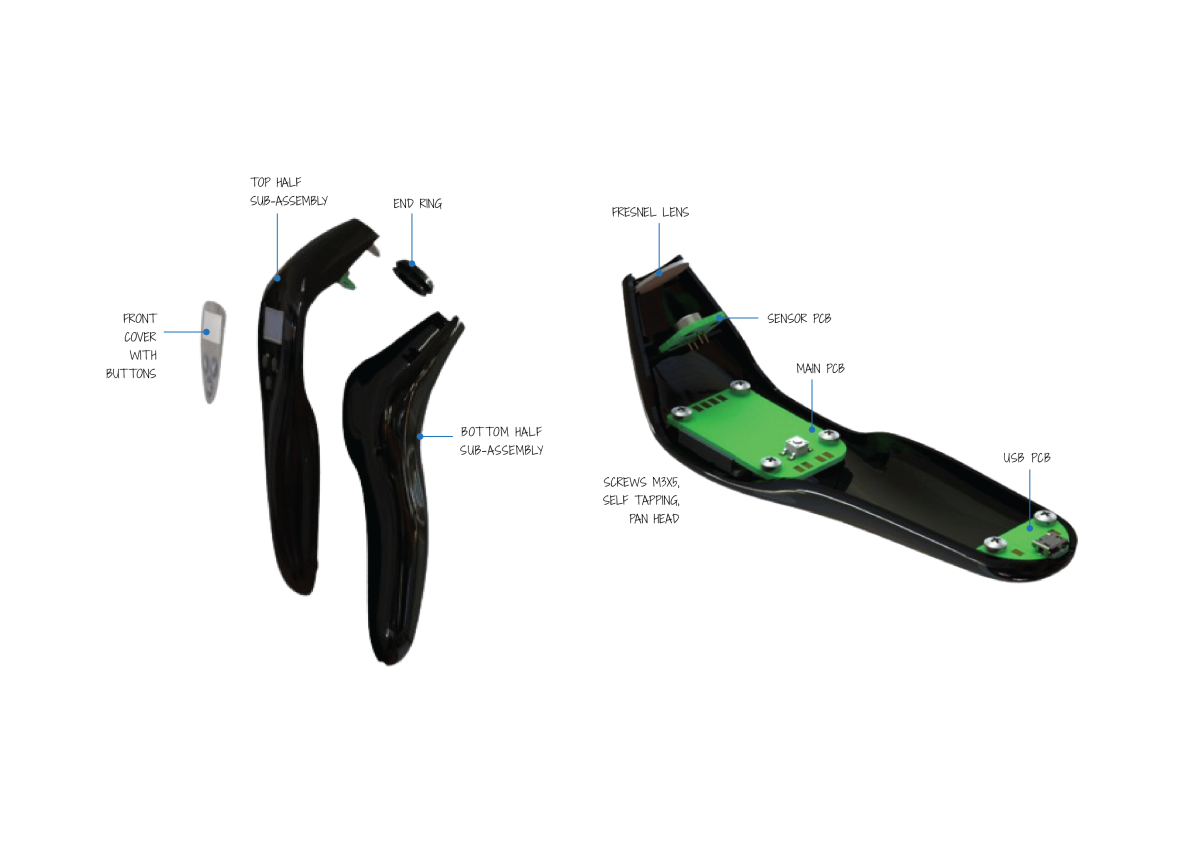
Part count is the highest-leverage variable in manufacturing cost, and it is decided almost entirely during design. Every part removed eliminates a tool, a supplier relationship, an inbound inspection step, an assembly operation and a potential failure point.
The enclosure architecture was consolidated so that structural, mounting and cosmetic functions were carried by fewer components. Features that would conventionally be separate parts — brackets, light pipes, retaining clips — were integrated into the moulded housing where the geometry allowed. Fastener count and variety were both reduced, so assembly requires fewer tool changes.
Designing the Assembly Sequence
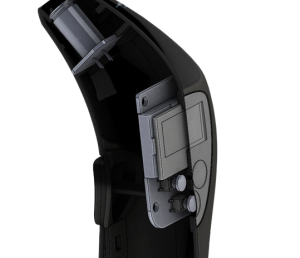
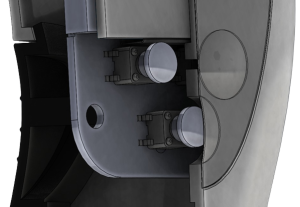
A device intended for high-volume local manufacture has to be assembled by operators who may be new to it. The internal layout was arranged so the build proceeds in a single direction, with no step requiring the partly assembled unit to be inverted or held in an awkward orientation.
Connector positions and cable routing were fixed so components can only be fitted one way, which removes a class of assembly error rather than relying on inspection to catch it. This is where DFM stops being a cost exercise and becomes a quality one.
Ergonomics for High-Frequency Use
The usage pattern for a screening device is unlike that of a clinical thermometer. An operator at a building entrance may take several hundred readings in a shift, one-handed, often while managing a queue.
The grip was shaped for sustained repeated actuation rather than occasional use, with the trigger positioned under the index finger at a natural rest position and an actuation force low enough not to accumulate fatigue across a shift. Control buttons were placed clear of the grip so they cannot be pressed inadvertently while the device is held.
The Outcome
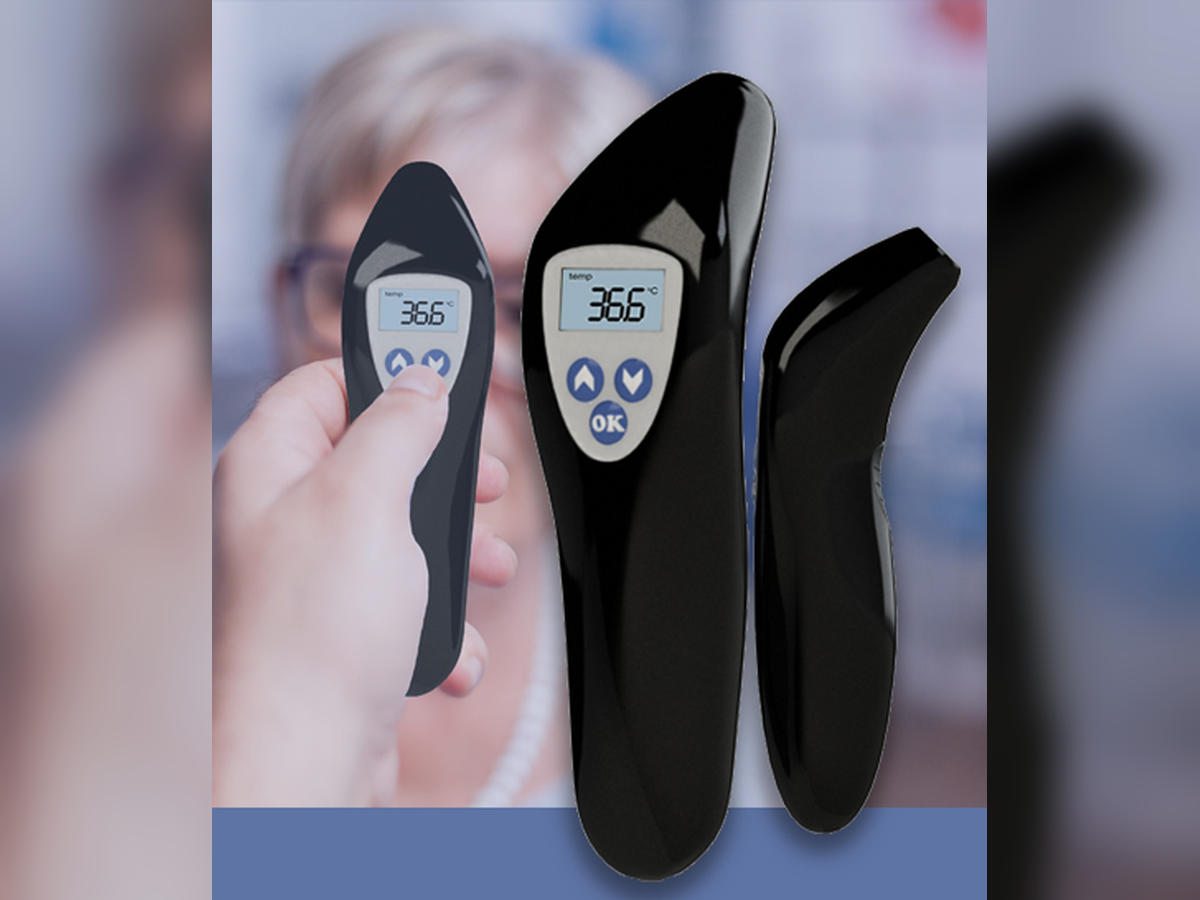
The project demonstrates how thoughtful industrial design enabled rapid development of an accessible and manufacturable healthcare solution.
The final solution delivers:
- Compact and lightweight handheld thermometer
- Reliable non-contact temperature measurement
- Comfortable one-handed operation with ergonomic grip
- Cost-effective design optimized for high-volume manufacturing
Conclusion
By treating manufacturability as a design input rather than a downstream problem, iOrbit delivered a non-contact infrared thermometer that could be produced locally at volume during a period when imported equivalents were unavailable at almost any price.
The wider point generalises beyond the pandemic. Component availability, part count and assembly sequence are decided while the geometry is still moving, and they are extremely expensive to revisit afterwards. Design for manufacturing is most valuable at exactly the point in a project when it is easiest to defer.